

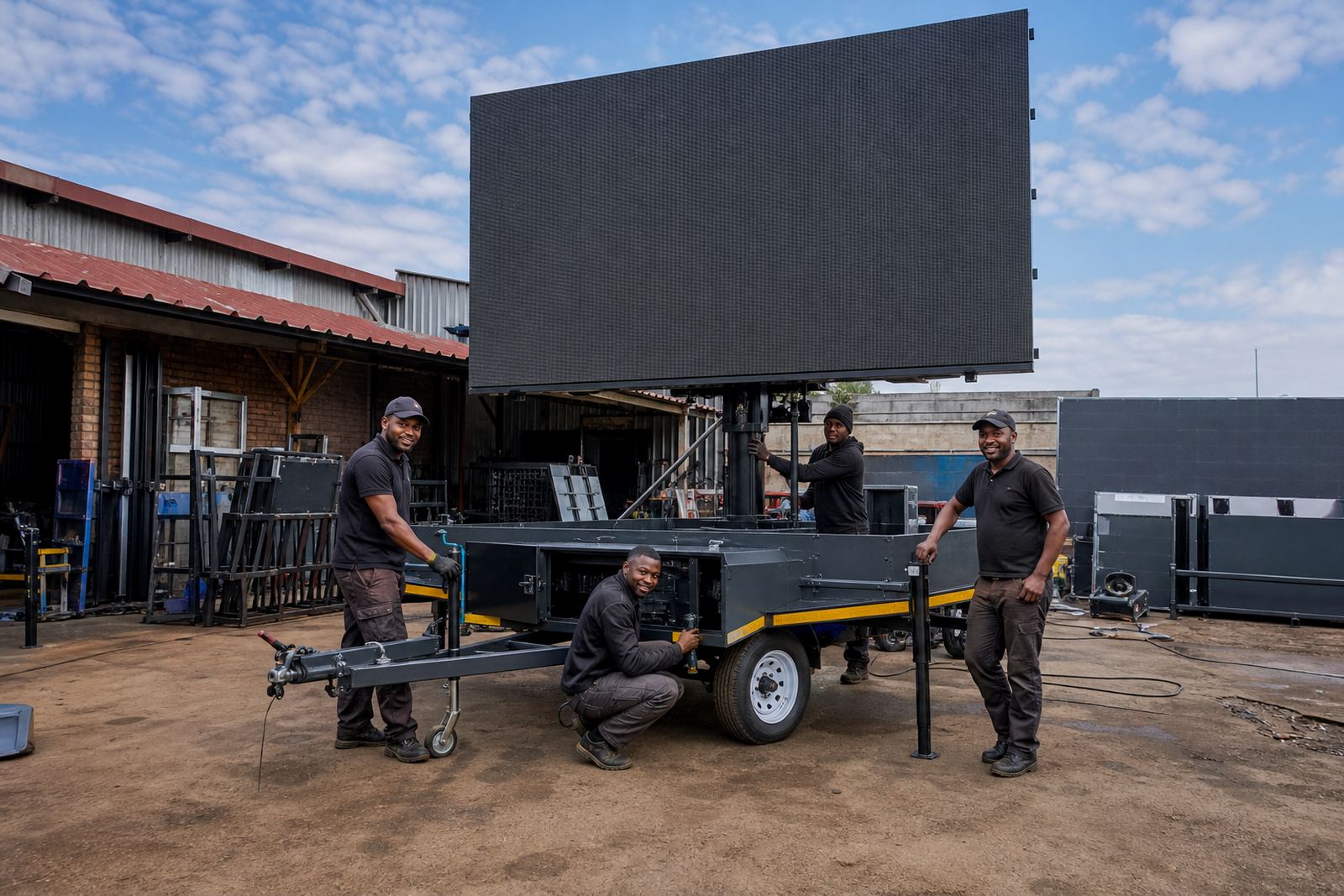
A Germiston workshop with the road in mind
LEDBox works from Germiston with a practical view of South African sites, from tight municipal streets to open event grounds and roadside activations. Our screens are built for outdoor viewing, with pixel pitch chosen for the distance people stand at, and brightness set high enough for daylight conditions. That matters when the crowd is moving, the weather shifts, or the site sits under hard afternoon sun.
We build and hire outdoor LED screen trailers and LED boxes for advertisers, event teams and roadshow organisers who need a screen that travels well and performs outdoors. Some days the job needs a trailer with hydraulic lift and rotation so the screen can be raised and angled on site, other days it is a fixed box arrangement loaded onto a venue space. The equipment changes, but the planning stays careful.
How the work is handled on site
Our jobs are not drop-off only. An on-site technician stays with the screen, checks the signal path, loads the content and keeps playback steady while the programme runs. When live feed support is needed, the technician works with the event team to keep the screen matched to the feed source and the venue timing. That support is useful at sports days, concerts, exhibitions and public roadshows where the screen is part of the live show rather than a background item.
- Site checks before delivery, including access, ground conditions and viewing lines
- Delivery and setup with trailer positioning, levelling and safe cable runs
- Content loading for adverts, playlists, sponsorship loops and event cues
- Playback management for timed campaigns and changing programme blocks
- Live feed support when a camera or match feed must be shown on screen
We also handle pack down once the programme ends, which helps keep the site orderly and the equipment ready for the next move. On longer routes, multi-stop planning keeps the screen moving through more than one town without wasted hours on the road.
Outdoor screens, power and weather judgement
Outdoor LED work needs more than a bright screen. It needs proper power planning, a safe wind limit for the trailer or structure, and a read on the weather before and during the job. Some sites use generator power, others can take mains power where the venue allows it, and both options need the load checked before setup starts. If the event sits in a coastal area or a place with sharp afternoon wind, the screen position and operating limits are reviewed with care.
Permit guidance is part of the job too. Outdoor screens can sit under local municipal rules, traffic controls or venue conditions, depending on where the unit is placed and how long it stays there. We do not treat that as paperwork only. A screen that is visible from the road or placed near public space needs the proper checks before it goes live, and the team needs to know where the unit may stand, turn or lift.
- Brightness set for daylight visibility on open sites
- Pixel pitch matched to the expected viewing distance
- Hydraulic lift and rotation used where the site allows it
- Generator or mains power planned to suit the venue
- Wind limits checked before the screen is raised or left running
- Municipal permit guidance where roadside or public placement applies
The people behind the trailers
LEDBox runs on people who know where a job can go wrong. Sibusiso Shezi leads the business, with Anika Chetty overseeing operations and keeping the moving parts in order. Thabo Bhengu looks after screen technical work, Ruan Mabena supervises fabrication, Noluthando Maluleke coordinates logistics, and Karabo Abrahams manages content playback. Each role matters when a screen has to travel, load, lift and run without fuss.
Fabrication, logistics and playback are not separate worlds in this line of work. The trailer must be built for the road, the screen must be protected in transit, and the content has to land cleanly on the display once the unit is in place. That is why the team talks through the route, the site and the content together, not in separate silos.
From Germiston to major South African routes
Our base in Germiston keeps us close to Johannesburg and the Ekurhuleni route network, but the work moves far beyond the East Rand. We deliver and set up in Pretoria, Durban, Bloemfontein and Polokwane, with planning shaped around distance, site access and the programme at hand. A screen heading to a sports day in one town may need a different timing plan from a campaign trailer parked at a roadside site the next week.
We also work across Kempton Park and other parts of Ekurhuleni where access, traffic and venue rules can change from one site to the next. That is normal for outdoor display work. The screen may be the same unit, but the route, viewing angle and operating plan are not the same every time.
- Germiston and Ekurhuleni for local build, storage and dispatch
- Johannesburg and Pretoria for city campaigns and public events
- Durban for coastal work that needs weather awareness
- Bloemfontein and Polokwane for regional roadshows and repeat route planning
A practical standard for campaigns and events
Our work is shaped by practical details that clients can see on site. The trailer must arrive clean, the screen must be readable, the playback must match the schedule and the unit must stand safely in the space provided. If the brief includes multiple stops, the route and handover points are worked through before the first move so that the screen is not held up by avoidable delays.
We keep the values simple: clear communication, careful setup and equipment that suits the job rather than forcing one unit into every brief. Some campaigns need a bright roadside display that holds attention in daytime. Others need a larger viewing surface for a crowd, with the technician managing clips, live inputs and sponsor boards while the programme runs.
What clients can expect from our side of the job
The company story is really a story of repeatable field discipline. We measure the site, match the screen to the brief, plan the power and keep a technician close to the equipment. That approach suits advertisers who want a moving display, event teams that need live content, and roadshow organisers who want one screen to travel through several towns.
Most jobs start as a short message about the date, the venue and the crowd, and we build the screen, route and operating plan from there. The aim is not fancy wording, it is a display that lands where it should, runs as intended and is packed down without unnecessary trouble.