

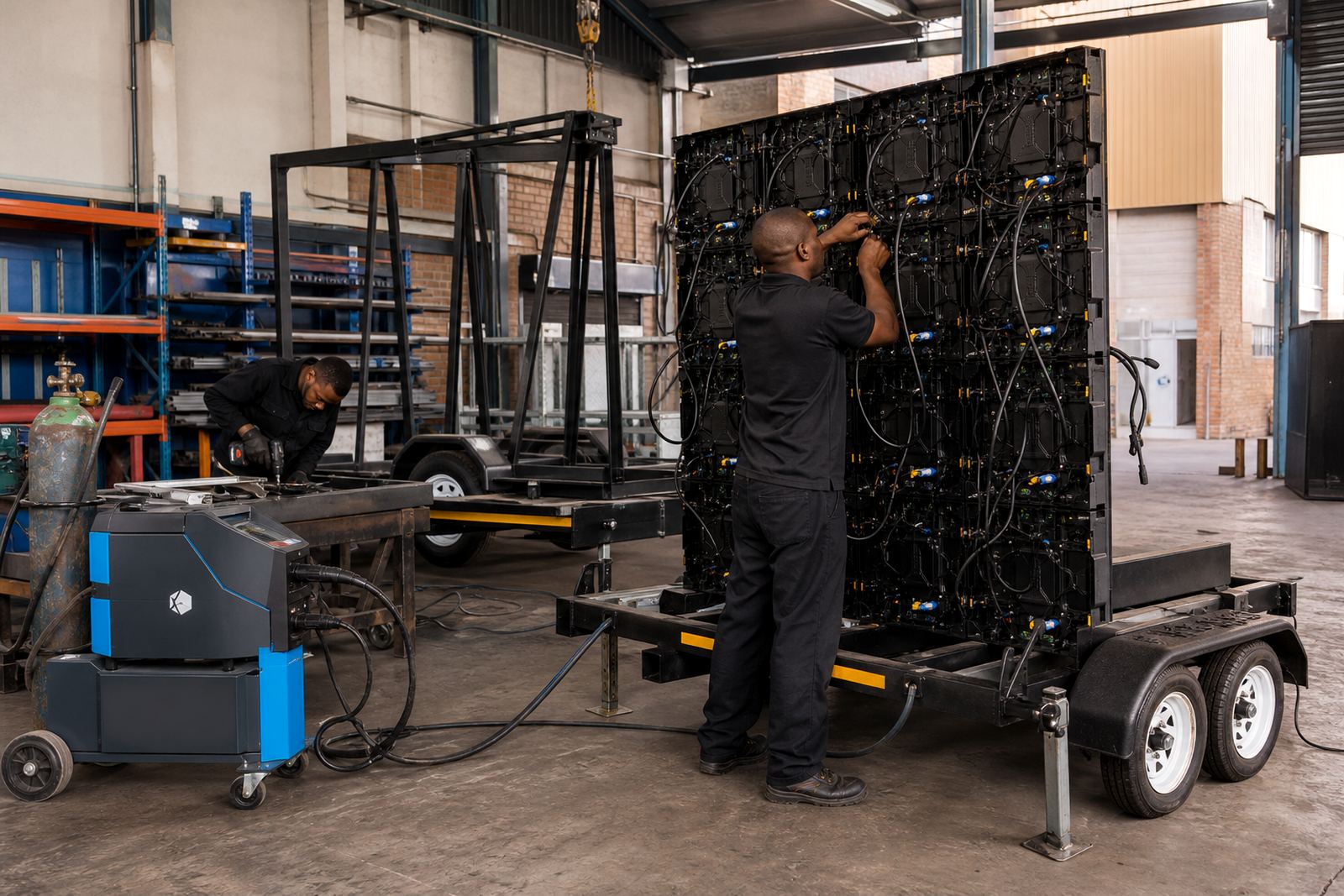
Where the work first took shape
The first jobs were driven by a simple need in the market. Advertisers wanted moving messages that could be seen in daylight, organisers wanted screens that could travel, and event teams needed a crew that understood how outdoor conditions change a screen job from one site to the next. That is where LEDBox built its name: on-site, under pressure, and with enough technical judgement to keep the picture steady.
From the start, the focus was outdoor display work rather than indoor truss-and-stage setups. Trailer-mounted LED screens made sense for roadside visibility, sports days, activations and roadshows because the screen could be brought in, lifted up, rotated into position and put to work without turning the site into a long construction project.
How the craft widened beyond one screen
As demand grew, the job stopped being only about the screen itself. The team had to think about pixel pitch, brightness levels that still hold up in daylight, the viewing distance on a busy field, and how content should be loaded before the first visitor arrives. A screen that looks fine in a workshop can behave very differently once it is standing in wind, sun and dust.
That practical side of the trade shaped the way the service developed. The screens had to be suitable for road use, outdoor viewing and quick site changes, with clear planning around power, access, stabilising and playback. Some sites used generator power, others could run on mains, and each setup asked for its own check of cable runs, safe positioning and weather conditions.
- Outdoor brightness that stays legible in full sun
- Trailer mounting for fast deployment and mobility
- Hydraulic lift and rotation for correct screen position
- Content playback checks before going live
- Wind and weather monitoring during the job
The people who keep the screen moving
The business is still shaped by a working team rather than a loose collection of hands. Sibusiso Shezi leads the company as Managing Director, Anika Chetty keeps operations moving, Thabo Bhengu oversees the screen work on site, Noluthando Maluleke handles logistics, Ruan Mabena supervises fabrication and Karabo Abrahams manages content playback. Each role matters because outdoor LED hire is never just transport and switch-on.
There is a fair amount of coordination behind each job. The logistics side has to match the route, timing and access on site. The fabrication side needs the trailer and screen structure to be ready for rough roads and repeated handling. The technician on site has to keep an eye on alignment, signal, brightness and the live environment around the screen. It is a hands-on arrangement and not one where a single person can do everything properly.
- Site checks before delivery and setup
- On-site technicians for operation and control
- Live feed support where a programme needs it
- Pack down and removal after the event window
- Multi-stop planning for roadshows and travelling campaigns
Who uses the screens and why they call for them
The customer base has always been broad, but the needs are usually very concrete. Advertisers want attention on a busy road or forecourt. Sports organisers need clear visuals for scoreboards, announcements or sponsor messages. Concert teams use screens to push live images and content to larger crowds. Roadshows call for equipment that can move between stops without losing time to a long rebuild.
In cities like Johannesburg, Pretoria, Durban, Bloemfontein and Polokwane, the same principle applies in different ways. A central business district may need stronger planning around access and permits, while an open sports ground may need careful weather checks and power planning. The work changes from site to site, but the expectation stays the same: the screen must arrive ready, load the content cleanly and perform in public without fuss.
What makes a trailer screen job different
Outdoor LED trailer work is shaped by the site, not only by the equipment. Wind limits matter, especially where a screen is raised high and left in the open. Hydraulic lift and rotation help with positioning, but the screen still has to be secured, levelled and set according to the actual conditions. If the municipal side of the job calls for permission or notice, that has to be handled in the usual way for the area and the event type.
Content management is part of the history too, because a screen is only useful when the message is loaded and running correctly. Some clients need a static loop, others want video, live feeds or timed changes during the day. Brightness settings may need adjustment for daylight or late afternoon viewing, and the playback process has to suit the crowd, the distance and the pace of the programme.
- Daylight visibility for outdoor audiences
- Rotation and lift control for the right viewing angle
- Power planning for generator or mains supply
- Permit guidance where local rules apply
- Weather monitoring for open-air sites
The Germiston base and the reach beyond it
Germiston remains the company base, with the wider Ekurhuleni area close to the daily rhythm of the work. That location suits the transport side of the business because trailers, screens and support gear can move out towards Kempton Park, Johannesburg and Pretoria with fewer complications than a remote base would create. It also keeps the workshop side close to the team that fabricates, prepares and tests the equipment.
Over time the business learned that outdoor screen hire is really a logistics service with a display function attached. The screen may be the visible part, but the story behind it includes route planning, weather awareness, safe loading, site entry, content control and pack down at the end of the job. Keeping that side tight is what keeps the work practical.
Today, LEDBox still handles each project as a site-specific job rather than a one-size arrangement. The equipment may be hired for a single campaign or a longer run, but the method stays grounded in the same habit: get the screen in place, keep the picture right, and make sure the site team has proper support while it is in use.