A trailer built for repeat stops and quick resets
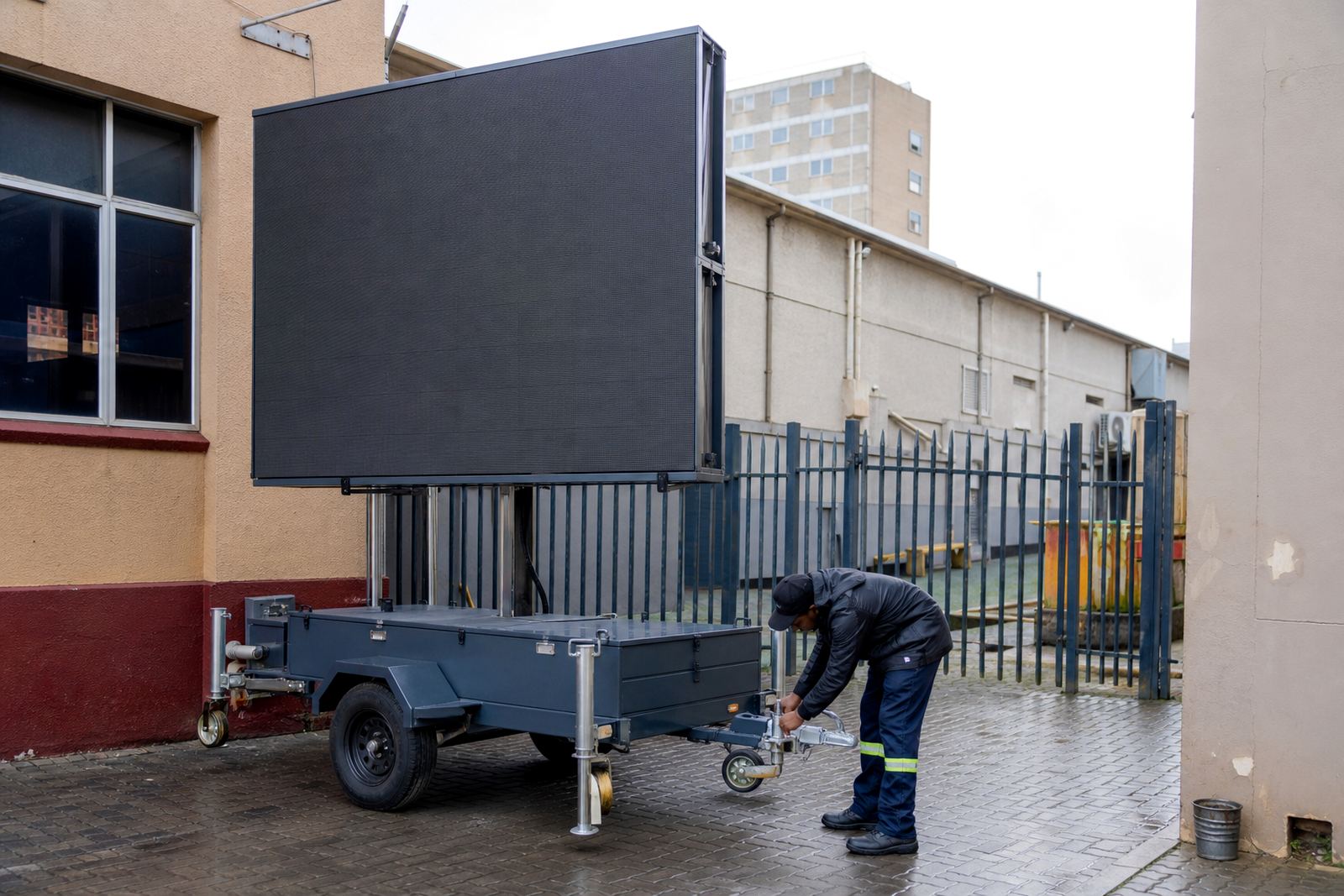
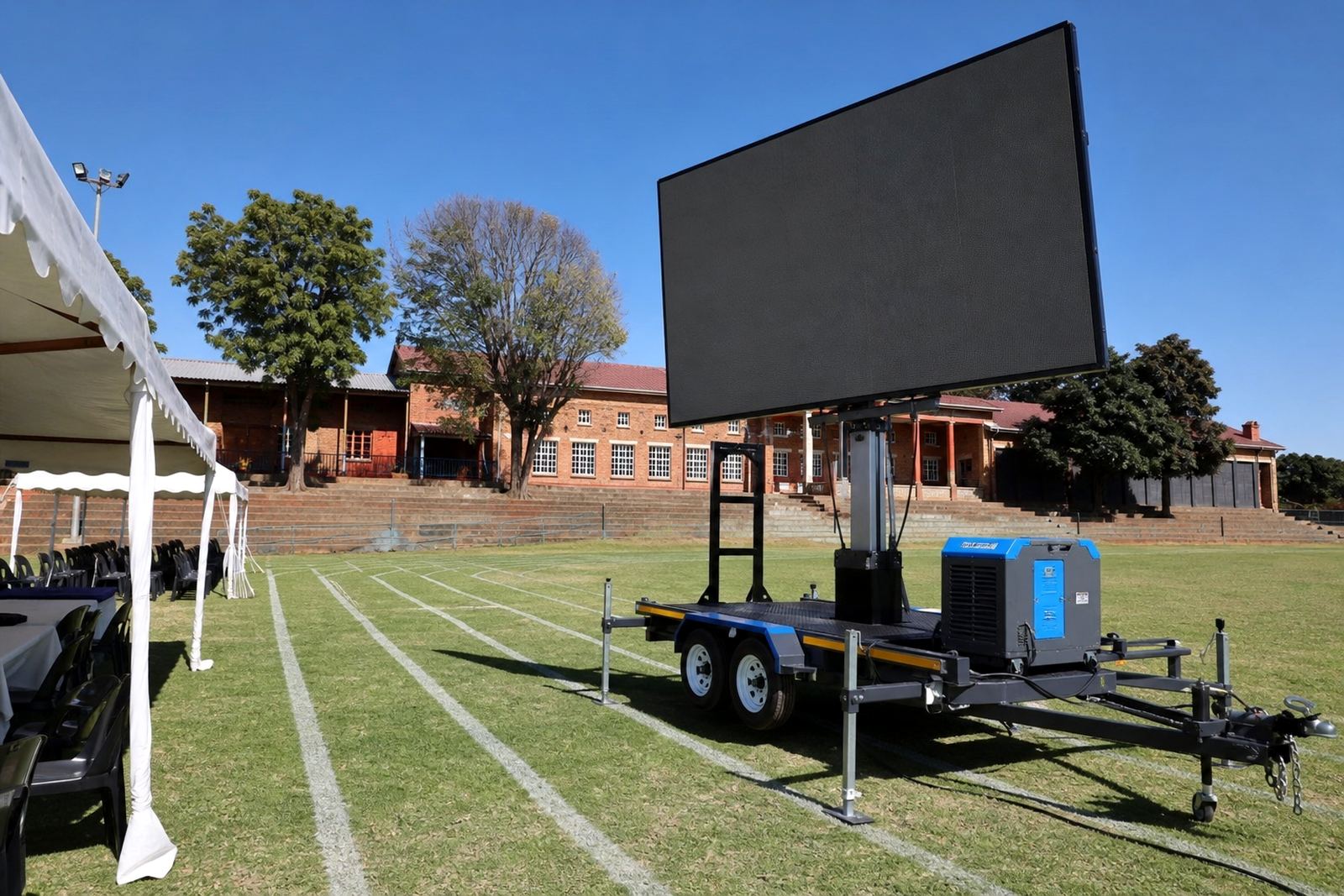
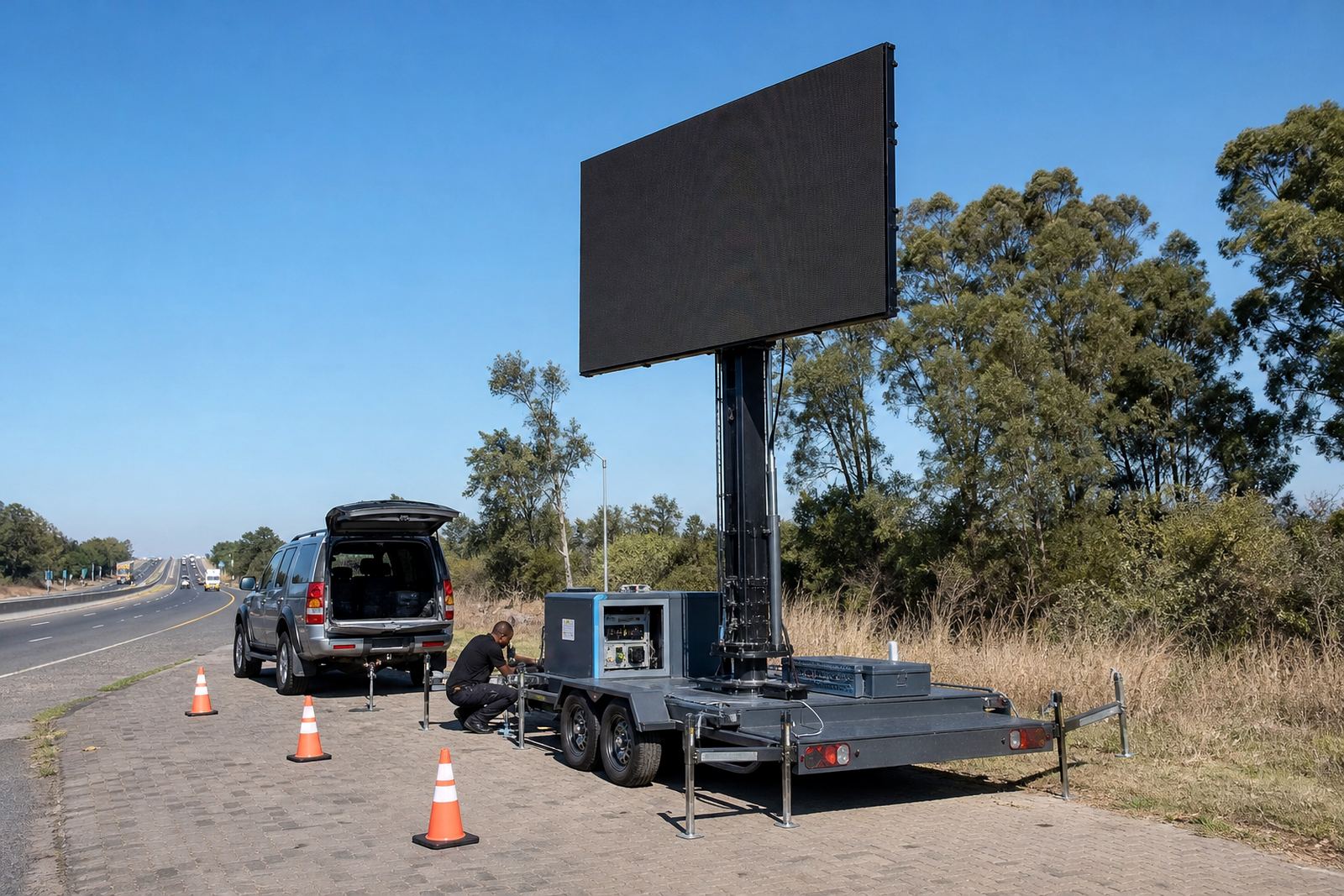
The roadshow trailer is designed for repeated pull-in, show, pack-down and move-on work. It carries the LED screen on a towable frame, with a hydraulic lift for height adjustment and, on many units, rotation for better sightlines at each stop. That matters when the viewing angle changes from a street corner in Johannesburg to a field edge in Polokwane or a retail parking area in Durban.
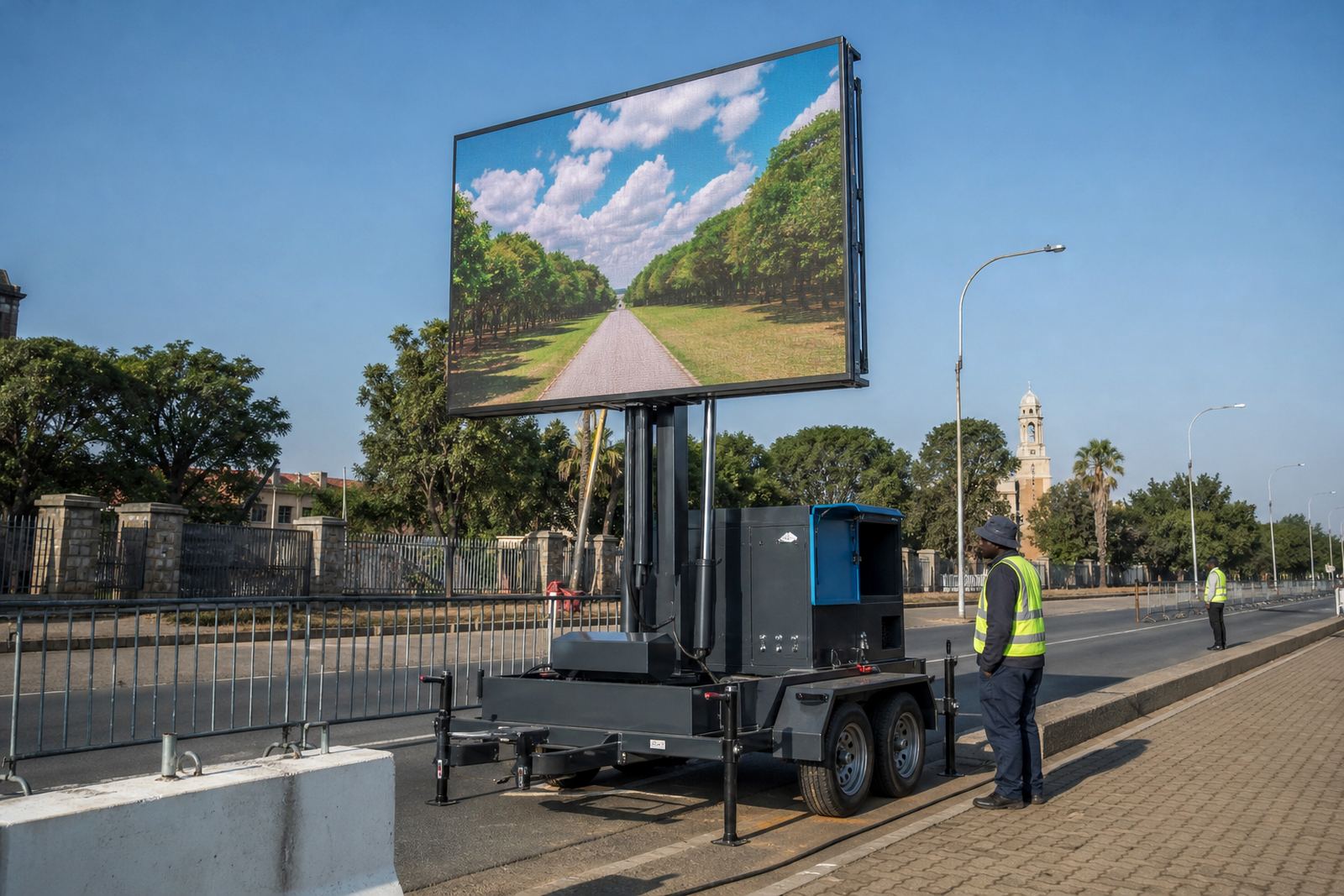
Outdoor LED cabinets are set up for daylight viewing, usually with fine enough pixel pitch for clear text, logos and motion graphics at closer roadside distances, while brighter modules keep the image readable in strong sun. The trailer can run from generator supply or site mains where that is available, and the playback system is loaded with your advertising loop, live feed or route-specific content before the move starts.
A roadshow unit is practical when the same screen has to serve more than one site in a day or over several days. The layout keeps cables contained, makes packing more orderly, and gives the technician a fixed structure to work from at every stop.
Screen sizes, pitch choices and viewing distance
We match the trailer to the distance people will stand from the screen. For street-level roadside work, a tighter pixel pitch gives cleaner detail on text and sponsor panels. For wider viewing zones, a larger cabinet format can make sense, especially where the audience is further away and the message is more visual than text-heavy.
- Screen size options are chosen around route access, viewing distance and towing limits.
- Pixel pitch is selected for the content type, from bold motion graphics to smaller copy.
- Brightness is specified for daylight use so the image stays visible outdoors.
- Cabinet layout can be configured for standard portrait or landscape content where the trailer design allows it.
- Hydraulic lift height is set for sightlines, nearby barriers and safe viewing clearance.
Trailer proportions also matter on tight suburban roads and in municipal spaces with access control. A smaller footprint can be easier to place near entrances, while a larger face works better where there is open frontage or a broad field edge. The right call depends on the route and the crowd pattern, not only on screen size.
Where a roadshow trailer earns its place
This format suits campaigns that travel between towns or need the same screen to appear in more than one place without a full rebuild. It is useful for outdoor launches, community activations, sports days, school grounds, dealership promotions, factory open days and civic messaging where the screen must move with the schedule.
Because the unit is mobile, it can be positioned for a temporary crowd and then relocated with less interruption than a fixed installation. That helps where road closures, permit conditions or site access change from one stop to the next. Our team works from Germiston and covers Ekurhuleni, Kempton Park, Johannesburg, Pretoria, Durban, Bloemfontein and Polokwane with delivery, setup and on-site support.
- Campaign routes with multiple venues over several days.
- Sports days and school events with changing viewing points.
- Concert pre-show areas and outdoor public gatherings.
- Retail activations with short stays and frequent moves.
- Municipal or community programmes needing visible public messaging.
For busy routes, multi-stop planning helps with access times, tow paths, parking angles and loading points. That is especially helpful where the trailer has to be positioned, run, then moved again without disrupting the next site.
Power, playback and the on-site technician role
The trailer needs a power plan that matches the site. Where mains power is available, the setup can be tied into the local supply with proper distribution. Where that is not practical, generator supply is used for the screen and related control gear. Either way, the display needs stable input and safe cable management, especially in public spaces and on uneven ground.
The playback side is handled on site too. We load content, check aspect ratio, set playlists and manage live feed support when the brief calls for it. If the route includes different messages at different stops, the technician can swap between loops or scheduled content so the screen fits each audience. Audio, if needed, is kept separate from the visual system and planned around the venue conditions.
An on-site technician is there to watch the screen during operation, handle content changes, monitor the power feed and manage the trailer during pack down. That gives the client one point of control on the day instead of trying to coordinate screen movement, content and setup across several people.
Permit guidance, weather checks and operating limits
Outdoor trailers need planning around local access and public use. Depending on the site, municipal permissions, parking approval, road proximity and by-law requirements may need to be considered before the unit is placed. We guide the process in general terms so the display fits the site layout and the venue rules without last-minute surprises.
Weather matters too. Wind loading, rain exposure and ground conditions can all affect placement and operation. The trailer is monitored for safe use, and the screen is not treated like a fixed wall mount that can ignore open-air conditions. If the forecast changes, the technician can adjust the setup, secure the unit, or hold the placement until conditions are suitable.
- Check access for towing, turning and final position on the site.
- Confirm whether the venue needs municipal or landowner permission.
- Allow for wind limits and stable ground where the trailer will sit.
- Plan for rain cover, cable routing and safe viewing space.
- Confirm any noise or generator rules if power is not taken from mains.
That kind of practical planning is part of outdoor work in South Africa, where the same route can include a paved forecourt, a dusty field and a coastal site with humidity in one week.
Care, moving and the finer points to secure
A roadshow trailer lasts longer when it is packed and moved with care. The screen face should be kept clean and dry, the locks checked, the lift mechanism serviced, and the trailer stored under cover where possible. Road movement can loosen fixings over time, so the frame, cabling and mounting points need regular inspection before another route starts.
When ordering, the useful details are the route, the stop count, the screen height you want, the viewing distance, the power option, the type of content and whether live feed support is needed. It also helps to note the site surface, access gates, any towing restrictions and whether the trailer must turn or sit in one direction only.
- Route towns and the sequence of stops.
- Target audience distance from the screen.
- Daylight use, evening use or both.
- Power source at each site, mains or generator.
- Content format, loop length and live feed requirements.
- Any permit or site access conditions from the venue.
LEDBox builds and hires roadshow trailers for campaigns that need a screen to travel well and work hard across repeated stops. From Germiston to Johannesburg, Pretoria, Durban, Bloemfontein and Polokwane, the trailer is set up to move, show and pack away with the route in mind.
Key facts
| Screen type | Outdoor LED screen trailer |
|---|---|
| Pixel pitch | Selected to suit viewing distance and content detail |
| Brightness | High brightness for daylight outdoor viewing |
| Lift system | Hydraulic lift with position adjustment |
| Power options | Generator or mains power, depending on site conditions |
| Operation | Playback management, content loading and on-site technician support |