When a launch needs more than a banner wall
Brand activations live or die on attention. A screen gives you motion, colour and a clear focal point, whether the crowd is gathered at a retail entrance, a sports field or a roadside stop. For outdoor use, the screen must stay readable in daylight and be positioned where people can see it without blocking walkways, access roads or emergency routes.
For activations in Germiston, Johannesburg, Pretoria, Durban, Bloemfontein or Polokwane, we plan for the site itself first. That means checking vehicle access, ground conditions, viewing distance and where the public will stand. If the event is on private property, the venue rules matter. If the screen sits near a road or public space, municipal permission and safety control may also come into play.
Most brand teams want looping media, timed product reveals, live social clips or a short sponsor reel. The screen can carry all of that, but the content has to be prepared in the right format before setup starts.
Trailer or box screen, matched to the crowd flow
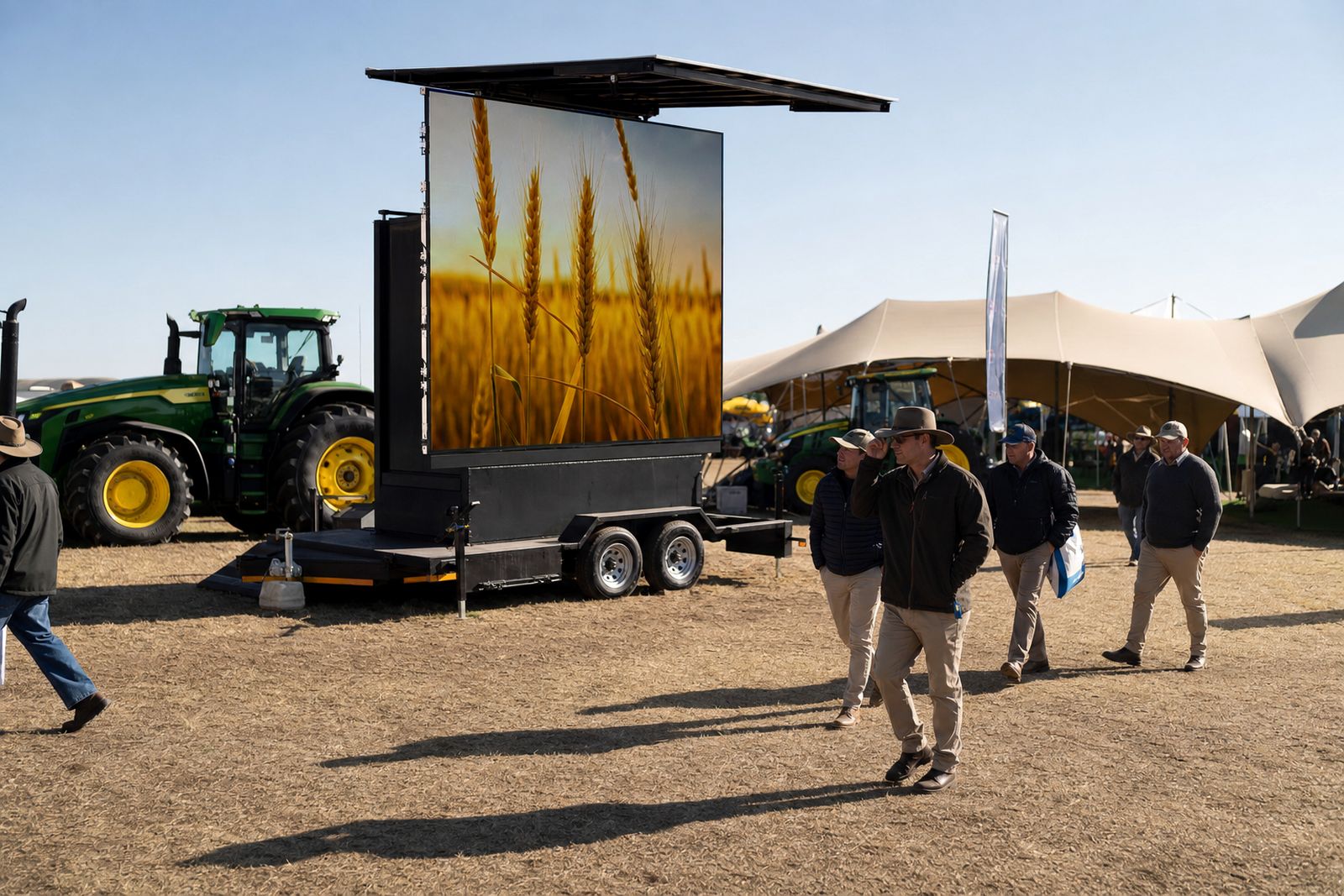
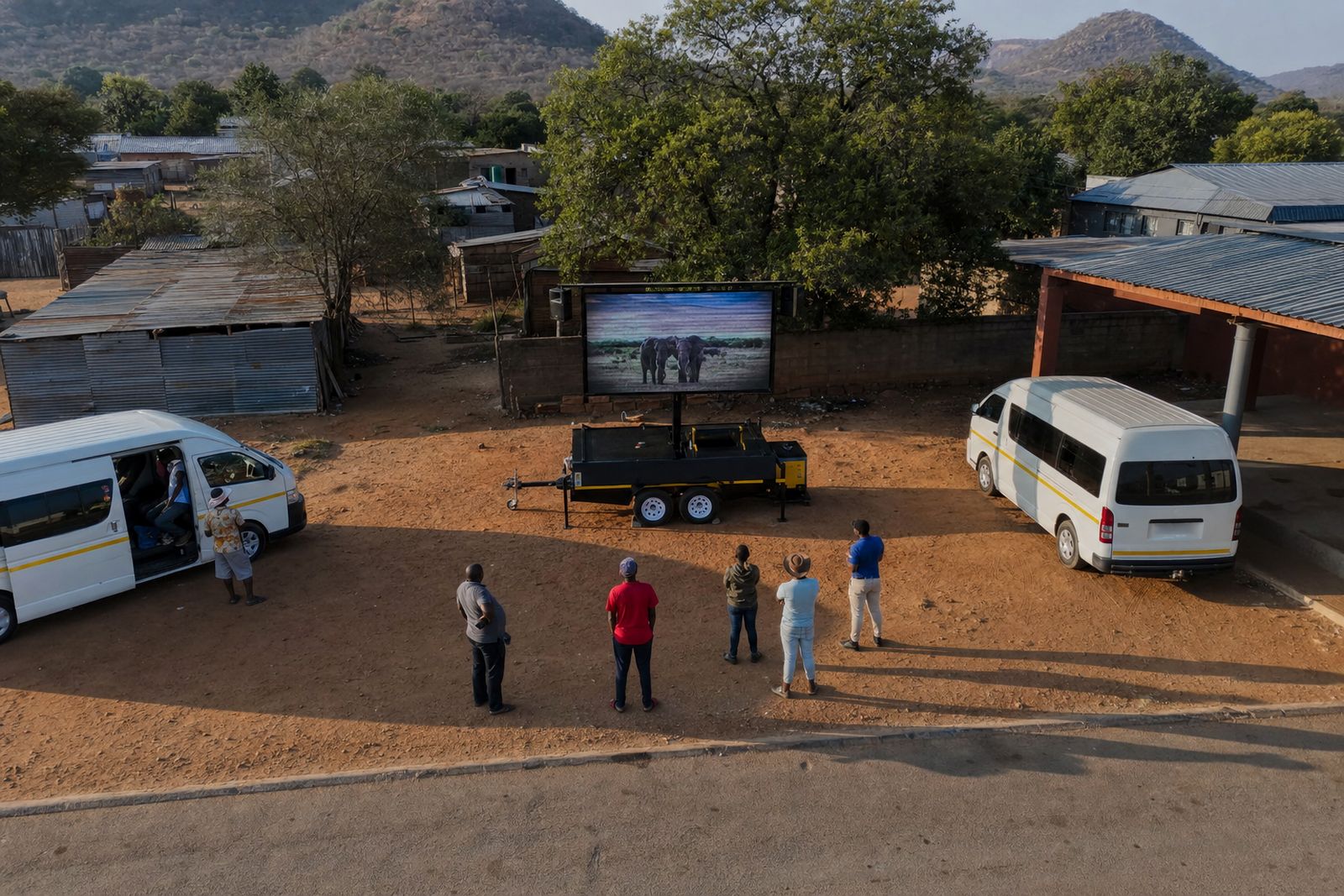
Outdoor LED screen trailers are useful when the campaign moves between sites. The screen folds into a towable unit, then lifts hydraulically into view. Some units also rotate, which helps when the audience sits on one side of a forecourt, oval or roadshow stop. LED boxes are suited to fixed placements and can be stacked or arranged for larger surface area.
Pixel pitch affects how crisp the image looks at different viewing distances. A tighter pitch gives finer detail for close viewing, while a wider pitch suits larger audiences who stand further away. Brightness also matters outdoors, because a screen that looks strong indoors can wash out in direct sun.
Our typical equipment set for activations can include:
- Outdoor LED trailer or modular LED box array
- Media player and playback control
- Power connection for mains supply or a generator where needed
- Hydraulic lift and screen positioning gear
- Cabling, safety barriers and weather protection steps
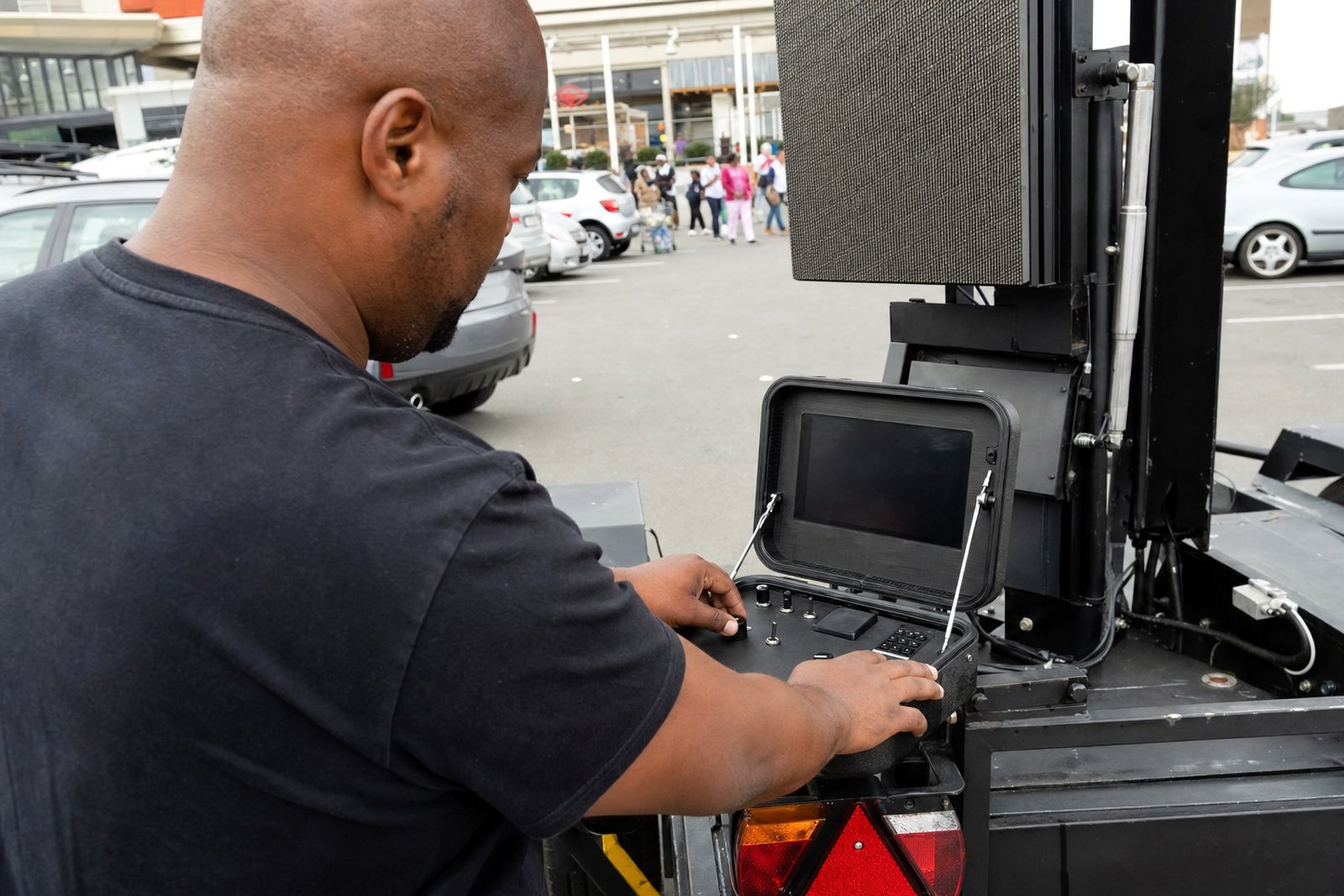
- On-site technician for setup, content loading and live feed support
Layout choices that keep the message in view
The best placement is not always the biggest open patch of ground. The screen should face the natural crowd line and sit high enough to clear heads, flags, pop-up tents and demo tables. If the crowd gathers at an angle, rotation can help. If the site has multiple touchpoints, the screen may need to face different zones during the day.
Spacing matters too. Put the screen too close and people miss the full image. Put it too far and the brand message loses impact. For a launch or sampling day, we often plan the screen alongside a product table, branded backdrop, entrance arch or activation queue so the flow feels organised rather than crowded.
Wind exposure also has to be considered. Outdoor trailers and raised screen structures have safe operating limits, and the technician should monitor conditions throughout the day. On open sites near the coast or in exposed municipal areas, the plan may need more clearance and stronger anchoring than a sheltered forecourt.
- Keep the screen facing the densest viewing area
- Leave room for access, cable routing and emergency movement
- Use daylight-safe brightness for open-air viewing
- Prepare short looping edits instead of long, quiet sections
- Load file formats that match the playback system before arrival
Content that works when people are walking, talking and stopping
Brand activations are rarely seated or silent. People arrive in clusters, talk over each other and only stop for a few moments at a time. That is why the screen content should be simple to read, with strong framing, short text and a clear call to action. Fast cuts can work, but only if the message remains obvious from a distance.
Live feed support is useful for product reveals, prize draws or sponsor mentions. The playback specialist can switch between videos, stills and live camera input, while the technician checks that the feed stays stable. If music, presenter audio or venue sound is part of the setup, the screen content and sound plan need to work together.
We also handle content loading before the public arrives. That includes checking aspect ratio, resolution, file order and the sequence of timed reveals. If a campaign has multiple cities, the same content may need small format changes so it fills each screen properly.
Common mistakes that make an activation feel flat
One of the biggest errors is treating the screen like a TV. Outdoor LED needs stronger visual contrast, larger text and simpler motion. Another mistake is placing the trailer where sunlight hits the face of the screen at the wrong angle. The picture can still play, but the impact drops off quickly.
Campaign teams also underplan for permits and access. A screen moving into a public-facing space may need local approval, traffic direction or venue sign-off. If the route includes several stops, packing one site too tightly can delay the next setup and complicate the towing plan.
Other problems show up in the content file itself. Wrong resolution, mixed aspect ratios and heavy video files can all create playback issues. We see this often when a launch has been edited for indoor use and then pushed into bright outdoor conditions without changes.
Rand ranges for a real activation brief
Budget depends on screen size, the number of days, travel, power requirements, content support and whether the job needs a trailer or a modular LED box build. Smaller single-day activations generally sit lower, while multi-stop roadshows or larger daylight screens move the figure up.
As a broad guide, a compact outdoor LED screen trailer for one event can start around R18,000 to R35,000, depending on the setup and travel. Mid-size activations with technician support and playback management often land between R35,000 and R85,000. Larger roadshows, multiple stops, live feed work or custom screen layouts can move beyond R100,000.
Those figures are only a guide, not a fixed rate. Permits, generator use, after-hours pack down, long-distance delivery and extra setup time can all change the budget. For campaigns running from Ekurhuleni into other provinces, transport and site access become a bigger part of the total.
Where the team fits into the day
Sibusiso Shezi oversees the project direction, while Anika Chetty manages operations and planning. Thabo Bhengu handles screen setup and field checks, Noluthando Maluleke coordinates logistics, Ruan Mabena manages fabrication, and Karabo Abrahams looks after playback and live content flow.
That structure matters on activation day because each part has a different pressure point. The driver needs the right access route, the technician needs the screen stable and level, and the content specialist needs files loaded before the crowd arrives. When the work is spread across Johannesburg, Pretoria, Durban, Bloemfontein or Polokwane, the planning has to stay tidy from the first site to the last.
Brand teams send the activation date, the venue and a rough idea of the content, and we come back with a screen plan. Site notes and route details can go in the same message.