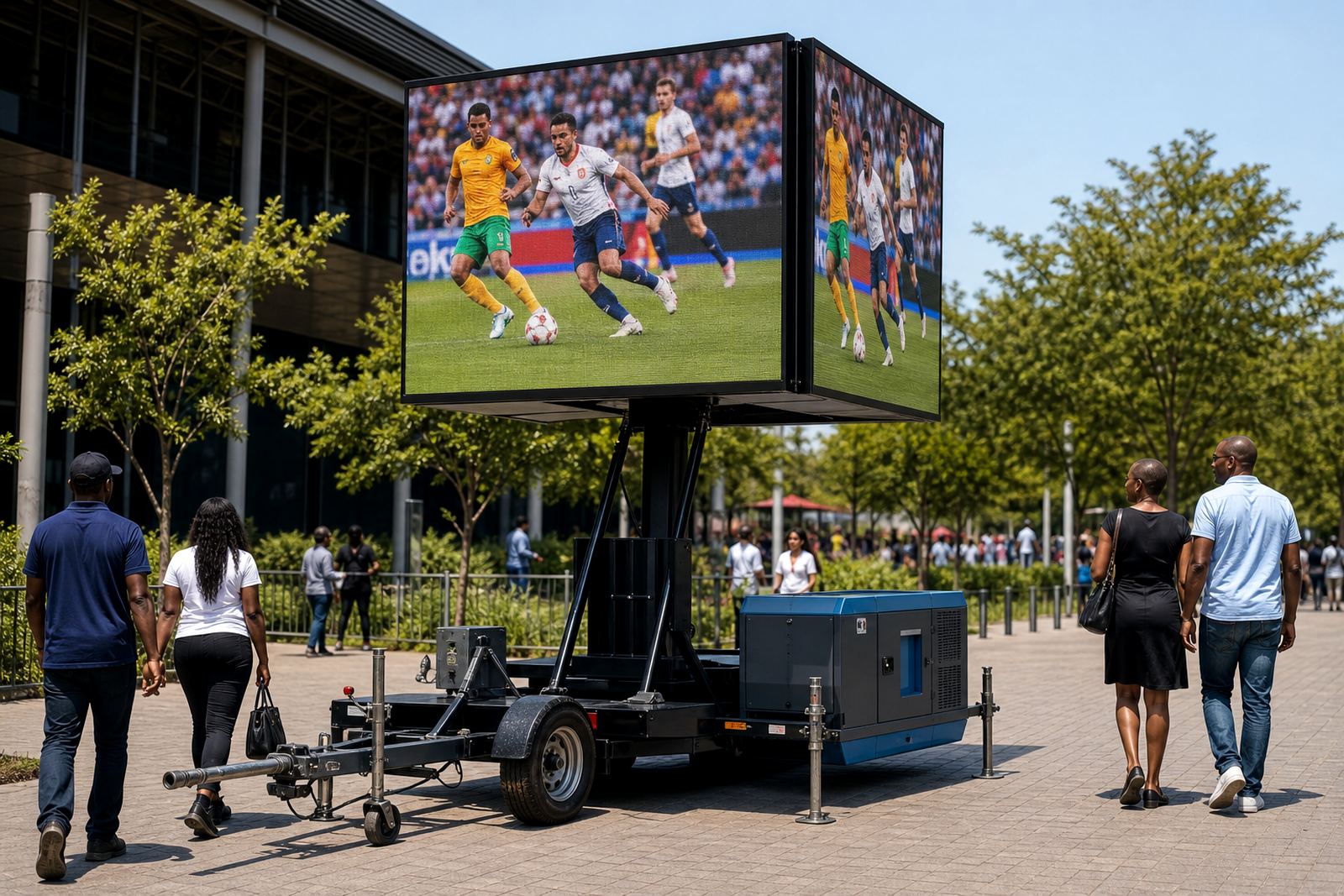

A trailer screen built for open-air viewing
The P5 Trailer uses a 5 mm pixel pitch, which suits outdoor audiences who are watching from a few metres back rather than standing close to the screen. It gives a clean balance between image clarity and viewing distance, so text, logos and motion graphics remain legible in daylight without pushing the trailer into oversized dimensions.
When we use LED screens outdoors, brightness counts as much as pitch. This screen format is specified for strong daylight visibility, with high-luminance panels that stand up to bright morning sun, overcast conditions and late afternoon glare. The cabinet layout is built for live outdoor work, with weather-aware handling and a structure that can be raised to a practical height for audience sightlines.
Because the screen sits on a trailer frame, it can be moved into position and set up where a fixed LED wall would be awkward. That makes it useful for promotions, municipal activations, sports days, dealership launches and roadshows where the viewing area changes from site to site.
Sizes, lift height and the way the screen moves
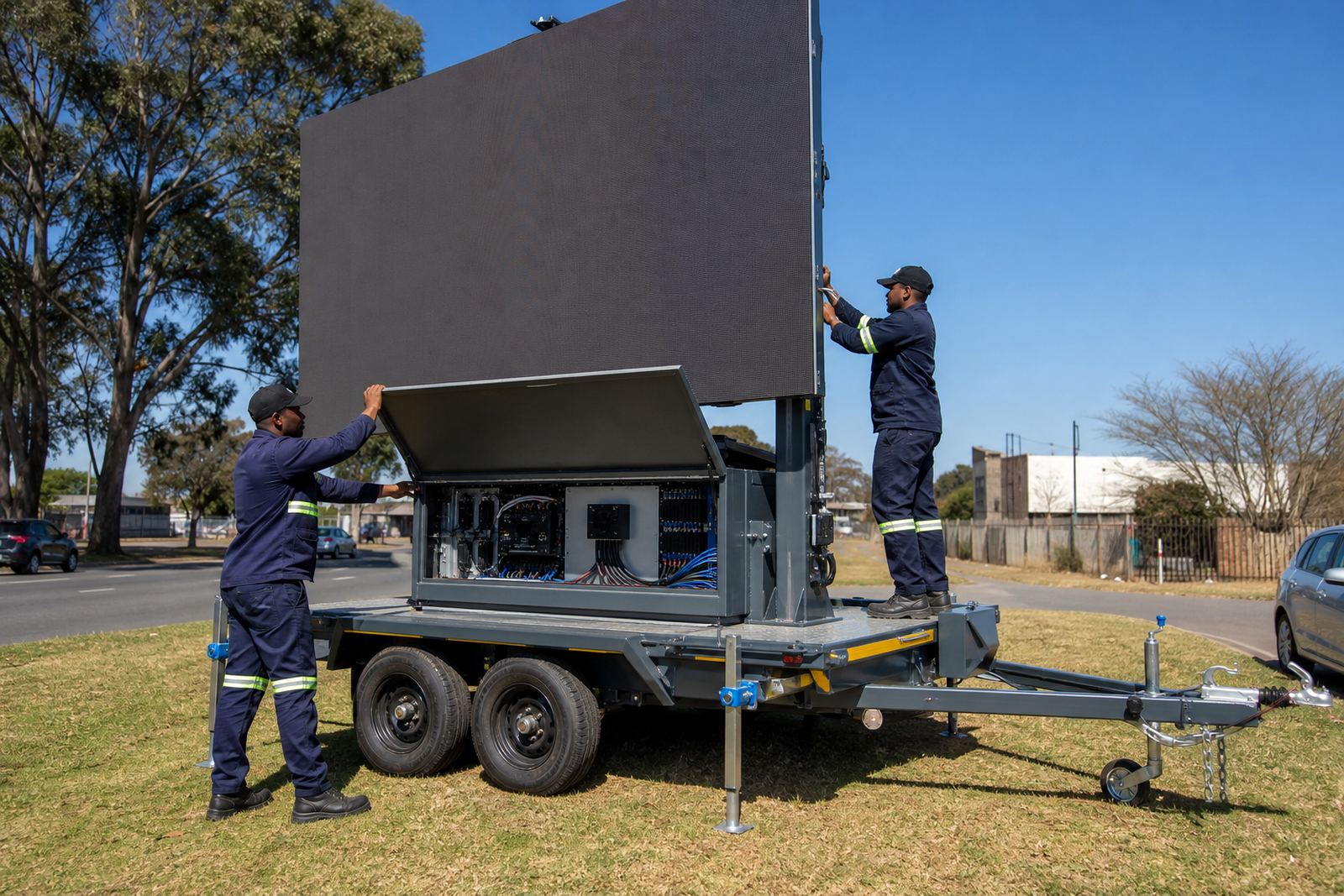
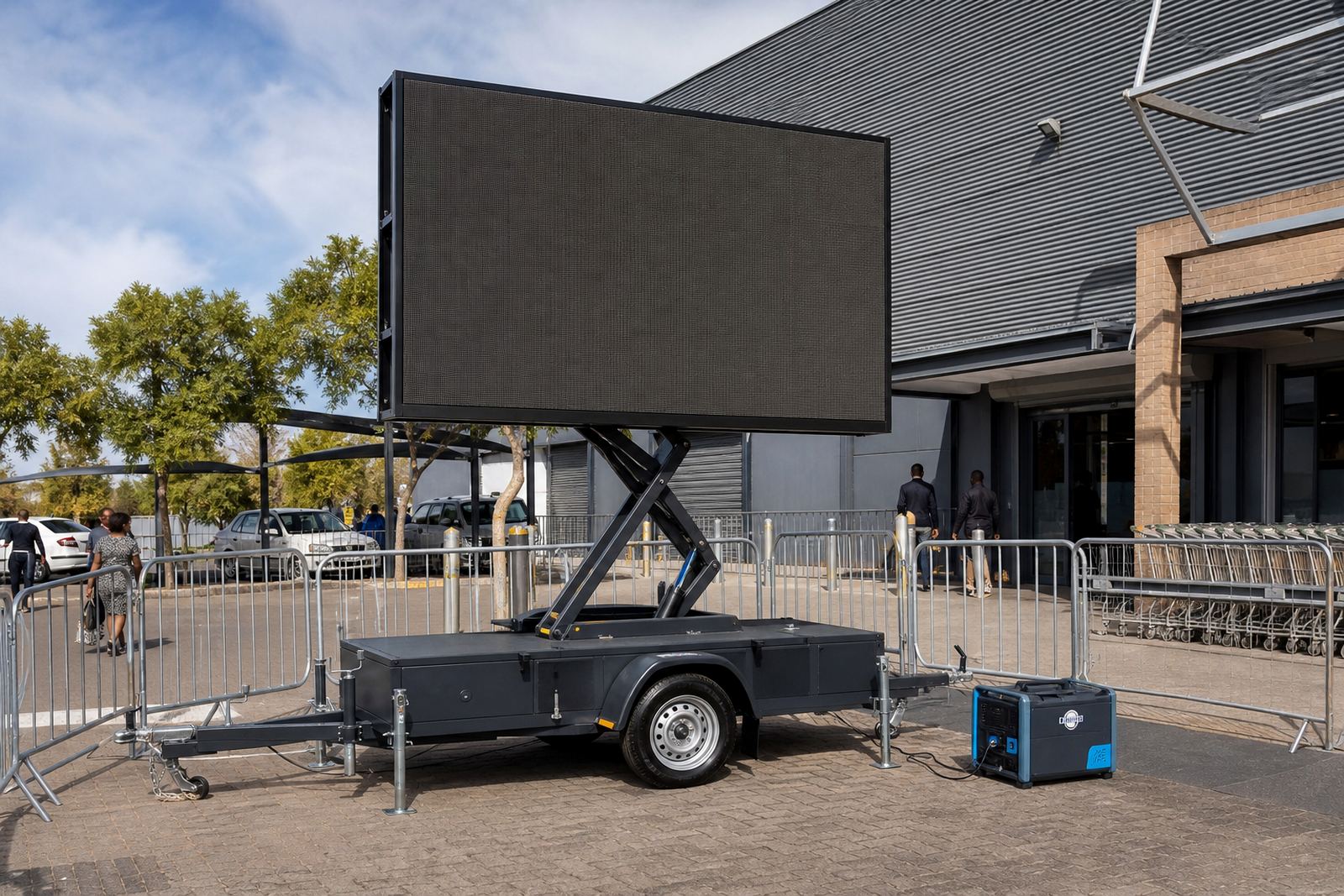
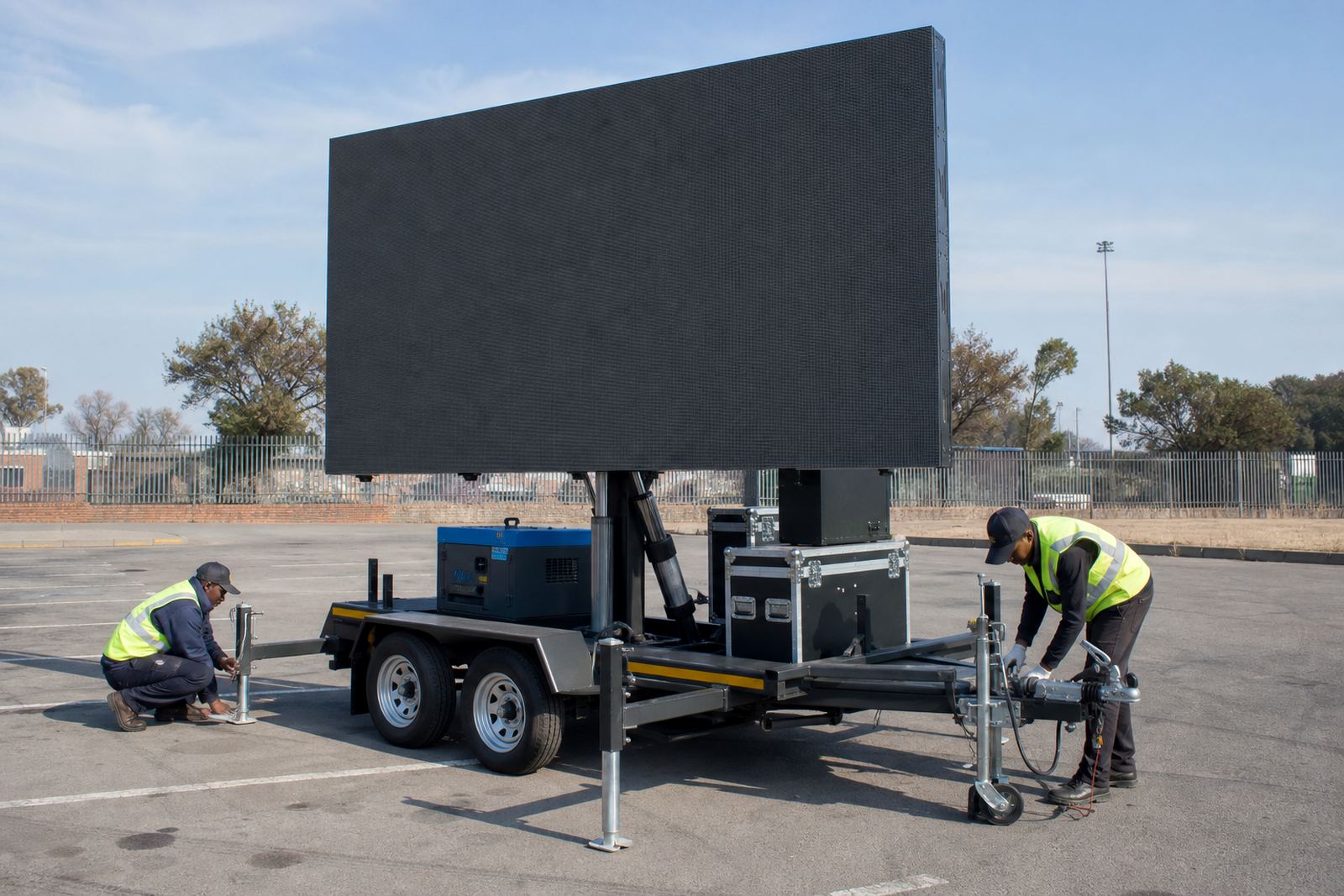
The P5 Trailer is available in trailer-mounted screen configurations that suit different site footprints and crowd sizes. The screen section is hydraulically lifted, which helps the display rise into view without manual stacking, and the assembly can rotate where the site layout needs a better angle to the audience. That rotation is helpful on open stands, forecourts and roadside pull-ins where people gather from more than one direction.
The trailer frame is planned for practical outdoor deployment, with a mast and support structure that keep the screen steady once positioned. The screen size, aspect ratio and folded transport height all matter when the unit needs to fit under site access limits, parking rules or entrance clearance. For some events, a more compact trailer is the better fit; for others, a larger format gives the message more presence across a wider audience area.
- Typical viewing use: daylight outdoor audiences
- Pixel pitch: 5 mm for balanced visibility
- Screen motion: hydraulic lift and controlled rotation
- Transport: trailer-mounted mobile unit
- Display use: video, stills, live feed and animated content
Power, playback and live content handling
The P5 Trailer can be run from generator power or from mains power where the site layout allows it. Power planning matters on outdoor jobs because the screen, control gear and any added site equipment need stable supply planning before the unit is switched on. Our team looks at cable runs, available distribution points and the best position for the trailer so the screen can operate without awkward leads across public walkways.
Content is loaded and managed on site, with playback control for looping adverts, scheduled messages and live feeds. Where the brief includes a broadcast source, live camera input or event feed, the screen needs the right signal path and a technician who understands source switching, aspect ratios and safe playback changes during the event. That is especially useful on sports days, product reveals and staged roadshows where the content changes through the day.
- Playback formats: still images, motion graphics, video loops and live input
- Source handling: media player, laptop or feed input as required
- Power options: generator or mains supply
- Event support: on-site operator for playback control
- Use case: timed messages and changing campaign content
Where the P5 Trailer fits best
This screen suits advertisers who need a mobile display with enough punch for outdoor viewing, but not the fixed commitment of a permanent installation. It works well at shopping nodes, public events, sports grounds, forecourts, launch sites and roadside campaign stops where people pass through in vehicles or on foot. The trailer format is also useful for multi-stop routes, because the same unit can be moved from one site to the next without rebuilding the display from scratch.
In South African conditions, the site itself matters. Open veld, hard paving, coastal humidity and windy corners all affect how the screen should be placed and operated. The trailer should be set where audience lines are clear, the wind exposure is manageable and access for delivery vehicles stays open. Municipal permits may apply depending on the site, the street frontage and whether the display is facing public space, so that part needs to be checked before the unit is placed in service.
For Johannesburg, Pretoria, Durban, Bloemfontein and Polokwane, the trailer format gives organisers a practical way to run outdoor messages without building a fixed screen structure. In Ekurhuleni and Germiston it suits yards, arenas and event spaces where access and setup time have to be handled carefully.
Keeping the screen healthy on real outdoor jobs
Outdoor LED equipment needs regular handling, not just occasional cleaning. The front surface should be kept free of dust, road film and any residue left by rain or coastal air, because build-up can dull the image over time. The trailer frame, hydraulic parts and locking points also need inspection before and after use, especially when the unit is being moved between sites in the same week.
Weather monitoring is part of normal outdoor operation. Strong wind can affect whether the screen is raised, held or packed down, and damp conditions call for careful cable management and sensible storage. After each job, the screen should be powered down correctly, secured for transport and checked for loose fittings, uneven panels or transport knocks. That sort of care keeps image alignment stable and protects the moving parts that do the hard work.
- Use suitable non-abrasive methods to clean the panels
- Check trailer locks, tyres and hydraulic points before movement
- Keep cables neat and clear of pedestrian routes
- Watch wind conditions before lifting the screen
- Store the trailer under cover where practical
What to confirm before the trailer is booked to site
When ordering a P5 Trailer, the useful details are the ones that affect positioning, power and viewing. Screen size, viewing distance, site access, surface type and event duration all shape the final setup. If the brief includes a live feed, the source device, signal path and content format must be clear before the trailer leaves the base.
It also helps to confirm the ground conditions, the turning space for the trailer and whether the site has a mains point or needs generator support. If permits or site approval are part of the job, those details need to be worked through with the venue or local authority in general terms, because public display rules can differ from one place to another. Once we have the site and the run times, the yard matches a P5 unit, the power source and the playback kit to the job.
- Screen size and expected viewing distance
- Daylight exposure and site orientation
- Power source: generator or mains
- Need for live feed, content loading or timed playback
- Access route, parking space and ground surface
- Permit or venue approval requirements where relevant
Key facts
| Product | P5 Trailer outdoor LED screen trailer |
|---|---|
| Pixel pitch | 5 mm |
| Brightness | High-luminance daylight viewing |
| Motion | Hydraulic lift with rotation option |
| Power | Generator or mains power |
| Service area | Germiston, Ekurhuleni and nationwide delivery |
| Support | Delivery, setup, on-site technicians and playback management |