
Reading the forecourt before the screen arrives
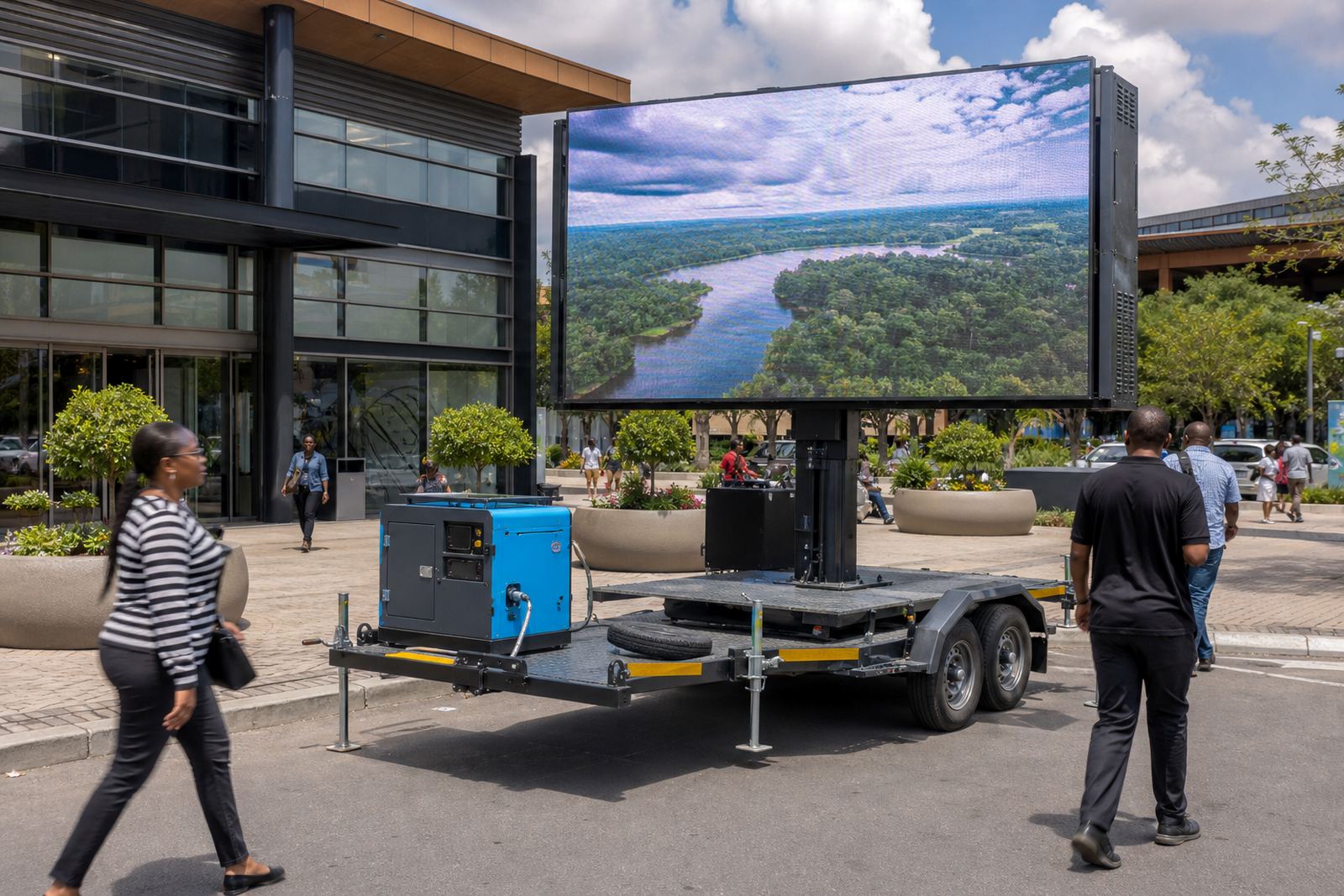
A mall exterior site behaves differently from a concert field or roadside verge. Shoppers are moving in and out of entrances, taxis may be turning close to the kerb and loading bays often share the same access roads as public traffic. A trailer mounted LED screen has to fit that movement without blocking sight lines or creating a bottleneck near the doors.
The first site check should look at where people naturally gather, where vehicles pause and how far the screen can be seen from the parking area. A daylight screen needs enough brightness for open sun, usually in the 5 000 to 7 000 nits range for outdoor work, while the pixel pitch should suit the expected viewing distance. A tighter pitch gives finer detail, though it does not replace proper placement. For mall forecourts the answer is often a balance between close reading and wide visibility.
In Germiston and the wider Ekurhuleni area, exterior space is often shaped by boundary walls, taxi routes and security gates. That means the trailer position is never just about the best view, it is also about a clear path for emergency access and a safe gap between the screen and foot traffic.
Trailer movement, lift height and rotation
Outdoor LED screen trailers are built for quick positioning, but the mechanics matter. A hydraulic lift raises the screen to a height that improves visibility over parked cars and crowd lines. Rotation helps the display face the main approach, which is useful when a centre has two main entrance directions or a forecourt that bends around the building.
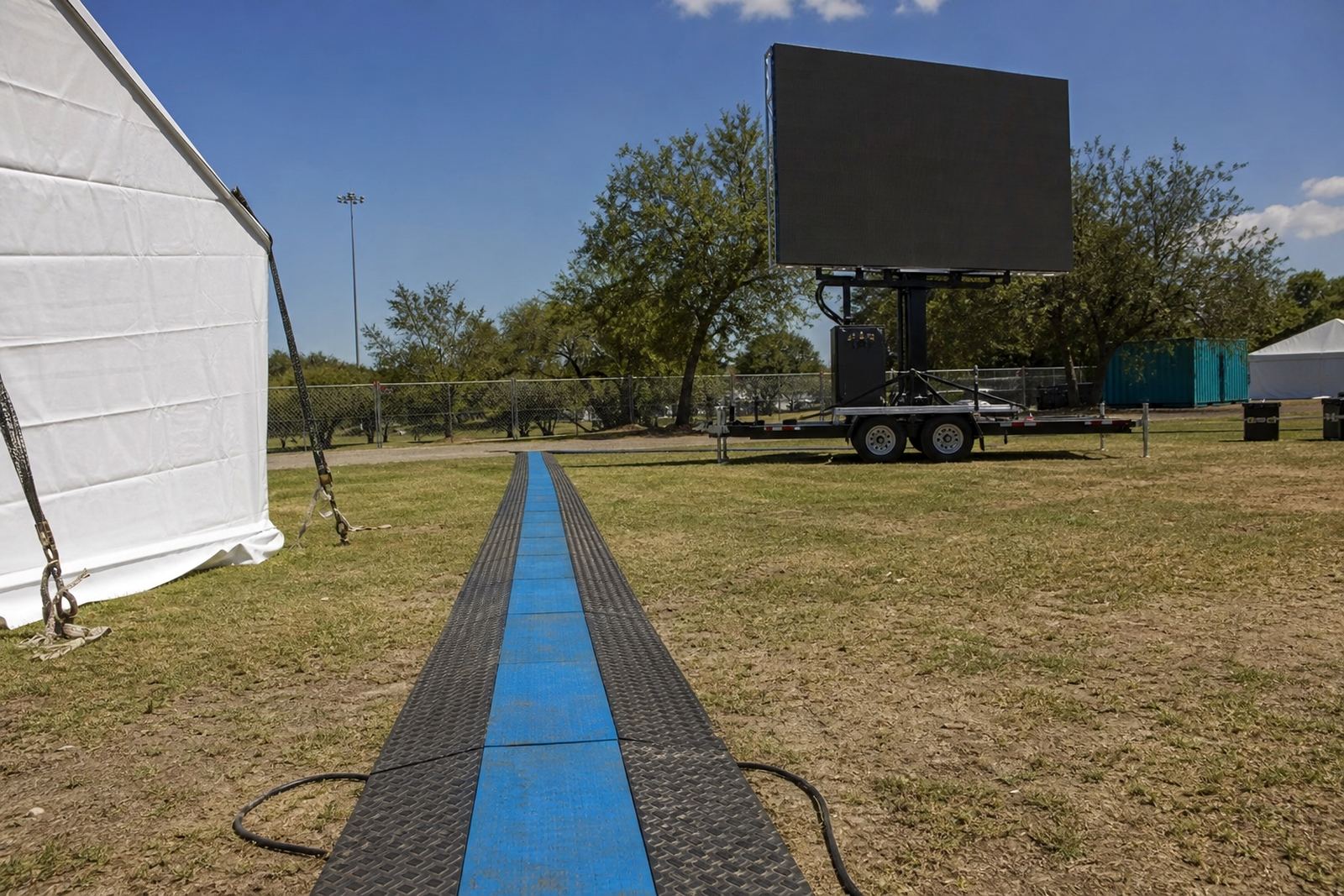
That movement has to be matched to ground conditions. Uneven paving, cable troughs and soft verges can affect stabilising feet and tow placement. On a mall site the trailer should be level, locked and set out so that the public cannot drift underneath the working area. If the screen is positioned too close to a driveway, even a small adjustment can create a queue at the wrong point.
- Check the turning space for the towing unit and any delivery vehicle.
- Allow room for outriggers, safety cones and a technician working space.
- Keep the screen face clear of tree branches, shade sails and signage poles.
- Set the angle for the main pedestrian approach, not only the car park.
For shopping-centre use, rotation is most helpful when the screen has to address a main road at one side and a pedestrian plaza on the other. That kind of placement should be mapped before delivery, not adjusted by eye once the forecourt is already busy.
Power, content and the parts people do not notice
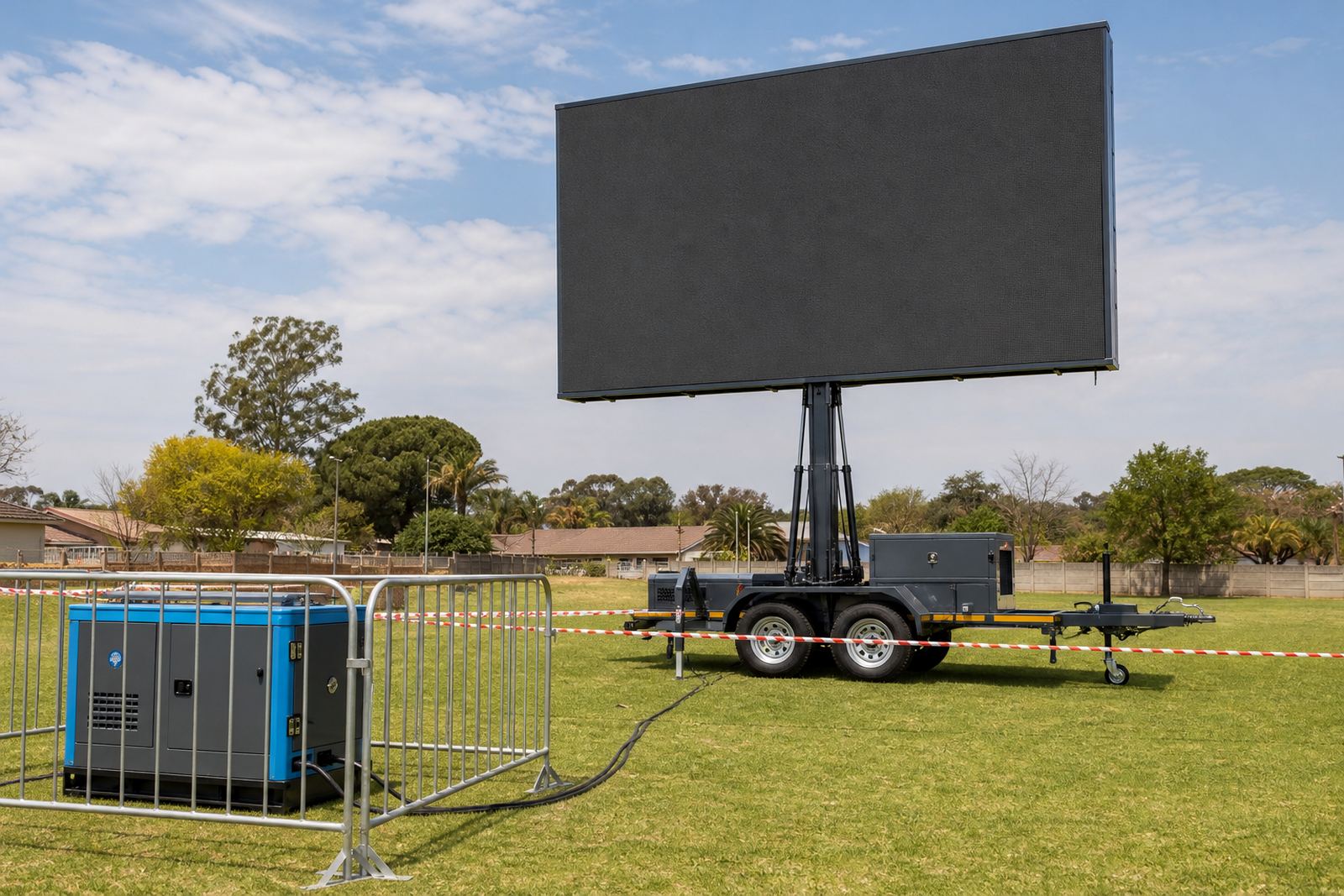
Mall exterior work usually runs on either generator power or a confirmed mains connection, depending on what the site can provide and how the delivery schedule is set. A generator gives freedom on open forecourts, while mains power can be suitable where the centre allows a controlled tie-in point. Either way, the supply must suit the screen load and the playback equipment that sits behind it.
Plan the content load alongside the site layout. Loops, sponsor boards, live feeds and timed messages all need testing on the actual screen size so that text remains readable from the intended distance. Bright sunlight changes how colour and contrast appear, and content that works indoors can wash out outdoors if it is not prepared properly.
Our team normally plans for:
- Format checks before content is loaded.
- Playback tests at the actual screen resolution.
- Live feed support where a programme or launch needs real-time switching.
- Backup files in case a source signal gives trouble.
- Clear naming of content sets for shorter handling on site.
On a busy retail site, the playback counter should never be treated like a hidden afterthought. It keeps the message steady while the forecourt carries on moving around it.
Wind, weather and municipal permissions
Outdoor LED trailers have to be managed with weather in mind. Wind limits depend on the trailer structure, the screen size and the manufacturer’s guidance, but the practical point is simple: if conditions rise beyond the safe operating range, the unit should not stay exposed. Rain, dust and coastal air all change the way a site is handled, especially in Durban where humidity and salt can work against equipment that is left standing too long.
Municipal permission is also part of the planning. Shopping-centre exterior deployments may need approval for access routes, display placement, traffic flow and any temporary structure that sits near public space. A mall manager may also want the screen tied into centre security, parking control and emergency access rules. Those checks can differ from one town to the next, so the plan should be built around the site, not copied from another venue.
When we work across Johannesburg, Pretoria, Bloemfontein or Polokwane, the same principle holds. Local rules, access windows and parking control all need to be respected before the trailer is moved into place. That kind of coordination saves time on the day and keeps the forecourt usable for shoppers and staff.
Keeping pedestrian flow open while the message stays visible
A mall exterior screen should support movement rather than interrupt it. The best placement gives shoppers room to pass, pauses the crowd in the right viewing zone and leaves clear sight lines for security personnel. If the screen is too near an entrance it can create a congestion point. Too far away and the message loses force because people are already walking past.
For advertising campaigns and roadshows, the visual line should support the centre’s own foot traffic pattern. That may mean facing the main car park exit in the morning, then turning towards the pedestrian plaza later in the day. It may also mean reducing sound levels where the centre management prefers a quieter forecourt. A good setup respects the site first and the content second.
- Keep entrances, fire lanes and taxi access free.
- Mark the screen perimeter so foot traffic stays outside the working zone.
- Coordinate with centre security before vehicles reverse into place.
- Plan any sound test around nearby shopfronts and opening hours.
In Ekurhuleni, one of the hardest lessons is that a forecourt can look wide on paper and still feel tight once shoppers, trolleys and delivery traffic start moving. That is why the site check matters more than a generic layout sketch.
How a Germiston mall setup made the difference
At a Germiston shopping-centre deployment, the screen was positioned to face the main pedestrian approach rather than the roadway. The lift height was set to clear parked cars, and the trailer was rotated slightly so the screen line matched the footpath from the entrance. Because the forecourt carried both public traffic and service vehicles, the team kept a wider safety margin on one side and used a generator away from the busiest walkway.
The content package was loaded before the public build-up began. That allowed the playback sequence to be tested while the light changed from morning shade to full sun. It also gave room to check visibility from the far end of the parking area, where smaller text often disappears if the contrast is too soft. The result was not about making the screen louder, it was about placing it where the mall flow already existed.
That kind of planning is what our site checks, delivery, setup, on-site technicians, playback management, power planning and permit guidance are there for. The trailer, the screen and the forecourt all need to line up as one working unit, especially when a shopping centre has to stay open while the installation is live.