
Start with the nearest people, not the furthest
The most useful distance is the one closest viewers will stand from the screen. If people gather 5 to 10 metres away, the image needs finer detail than a screen aimed at a roadside audience 20 metres out. The eye notices rough edges first when the pitch is too coarse for the viewing point, and that makes text harder to read.
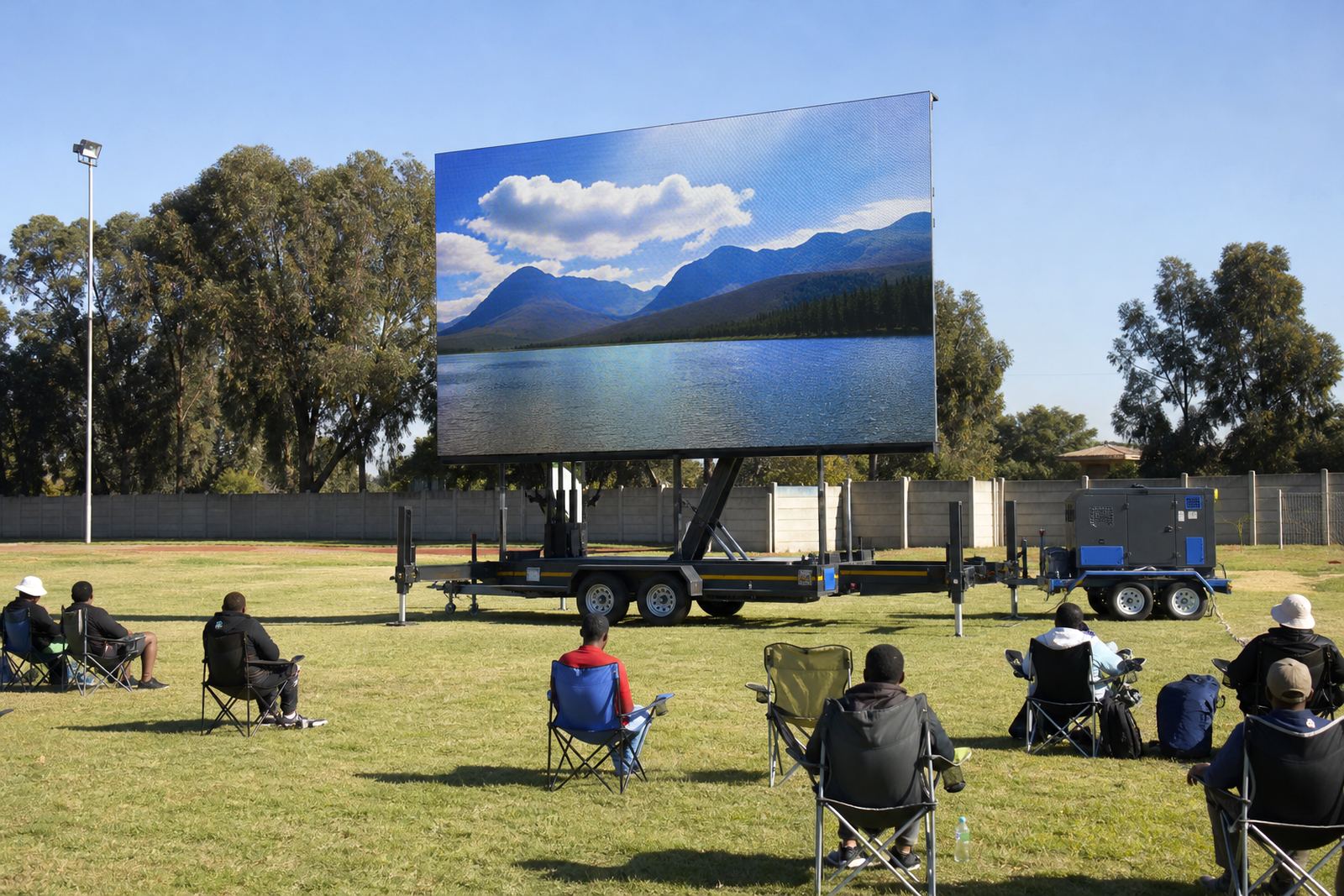
For outdoor LED screen trailers and box screens, the crowd shape matters as much as the site itself. A sports day field, a busy intersection, and a roadshow stop each create different sightlines. A screen that suits a broad open lawn may feel oversized for a narrow forecourt, while a compact unit can disappear on a large site with long viewing lines.
At LEDBox, distance planning is part of the early site check. We look at where people will stand, where vehicles pass, and how the screen faces the sun. That helps decide whether the display should favour tighter detail, stronger presence, or a larger surface area with simpler content.
Pitch, screen size and budget work as one decision
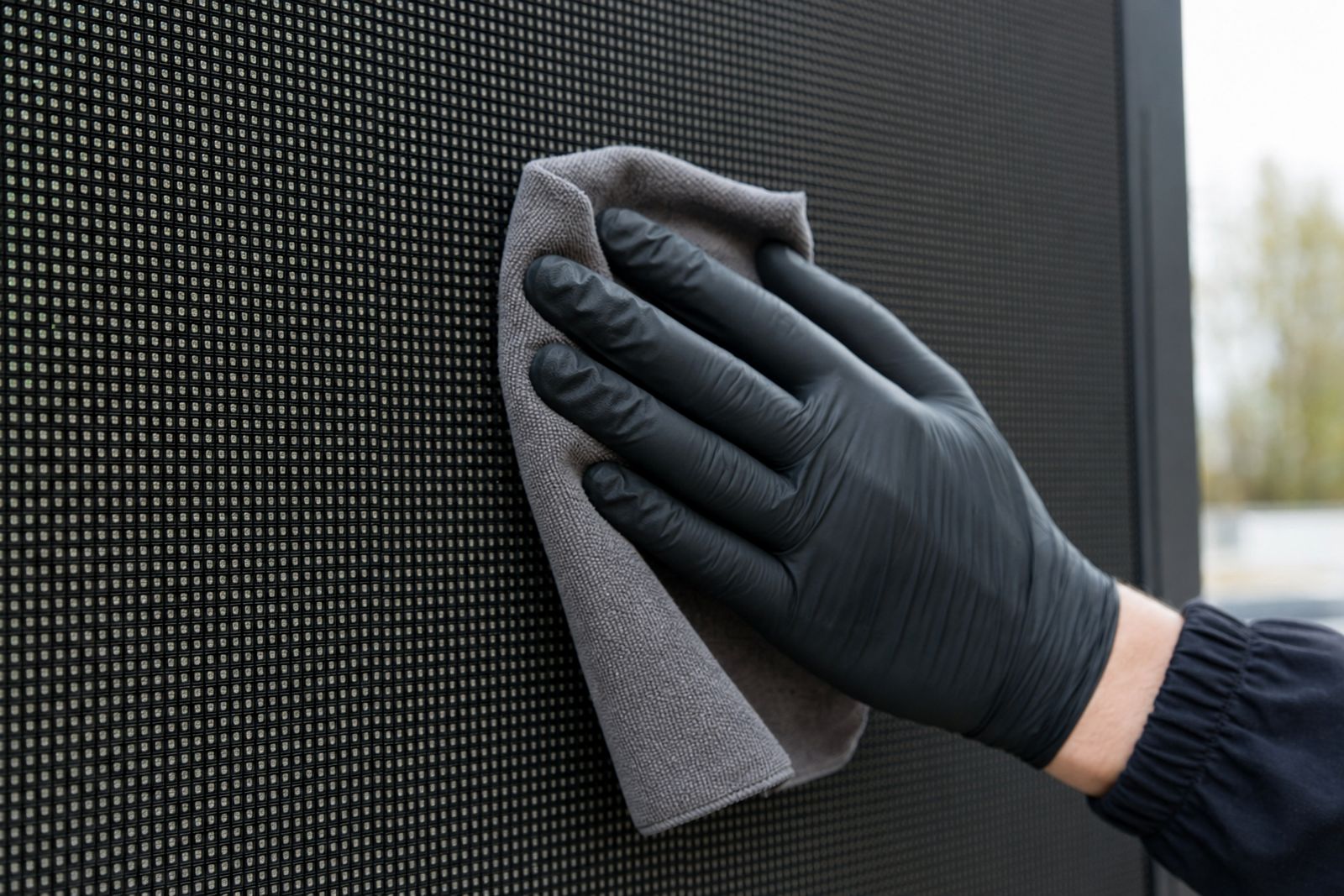
Pixel pitch is the spacing between the light points on the panel. Smaller numbers usually give finer detail and better legibility at shorter range, while larger pitches can suit longer viewing distances and help keep the hire cost in check. The trick is not to buy the finest pitch on offer, but to match the screen to the audience distance and the content.
Text-heavy slides, sponsor lists, scores and live captions need clearer resolution than a moving background and a big logo. If your crowd is standing close enough to read smaller type, the screen needs to hold detail without looking blocky. If the audience is further away, a larger pitch can work well, provided the content uses bold lettering and strong contrast.
Budget follows the same logic. A tighter pitch and larger cabinet area both increase the cost, but so does asking a screen to do a job it was never sized for. A well chosen screen can sometimes save money by avoiding overspecification, especially on short campaigns or multi-stop roadshows where the distances stay similar from town to town.
Brightness matters when the day is bright and the sky is open
Outdoor screens must stand up to direct sun, pale concrete, reflective vehicle surfaces and long daylight hours. Brightness is measured in nits, and outdoor units need enough punch to remain readable in harsh light. If the screen sits in shade, the requirement drops a little, but most outdoor jobs in South Africa need a strong daylight spec.
That does not mean brighter is always better. Excess brightness can wash out colour and make close viewers uncomfortable in the late afternoon. Good content balance matters too, with clean contrast, simple backgrounds and large type carrying more weight than clever animation. For a roadshow on an open municipal field, brightness and viewing angle should be planned together, not treated as separate choices.
- Use bold fonts for short messages and scores
- Keep backgrounds darker when the sun is strong
- Leave generous spacing around logos and captions
- Leave out fine lines that disappear when viewed from far off
Hydraulic lift, rotation and site geometry change what people see
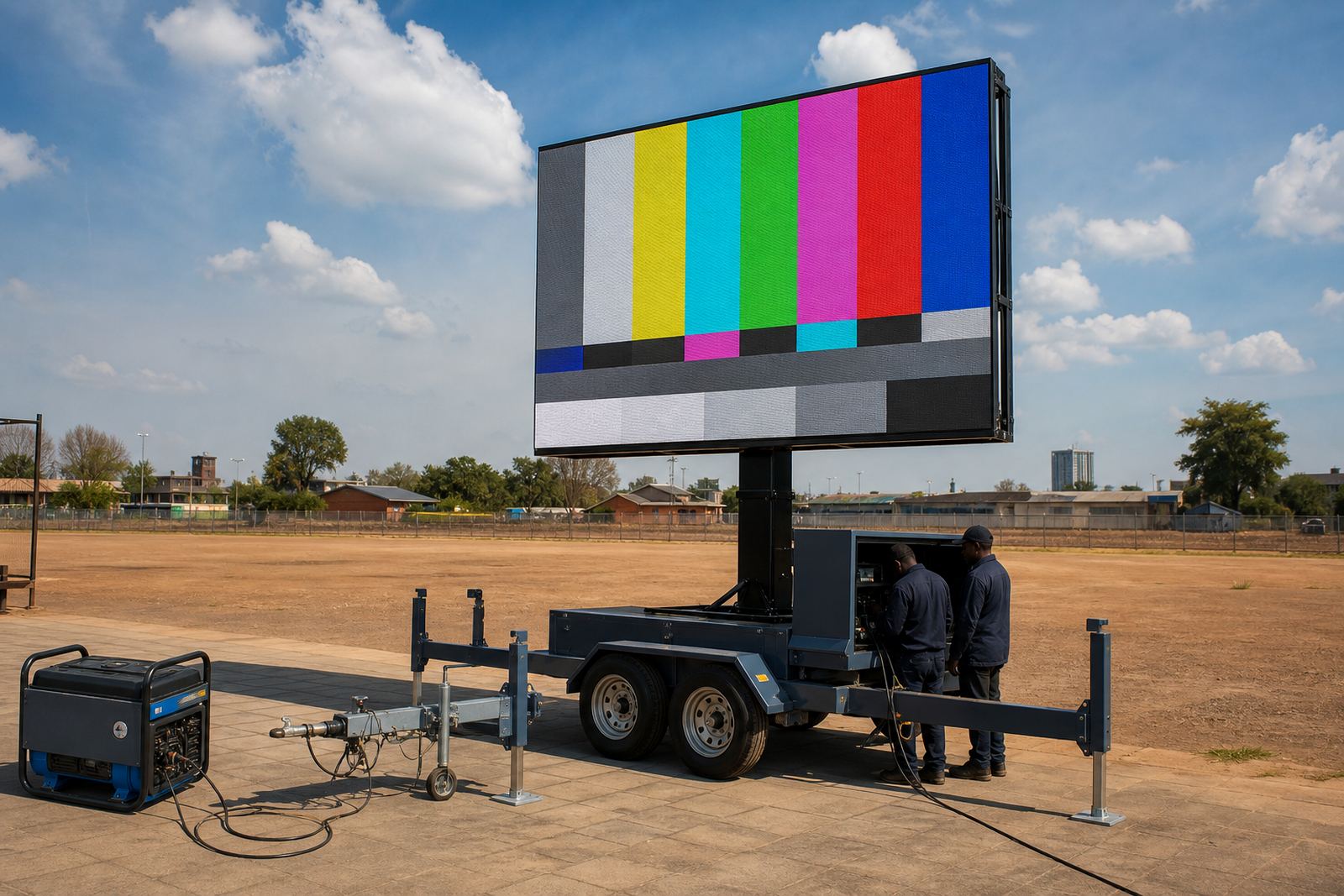
Trailer mounted LED screens are not only about panel size. Hydraulic lift systems help raise the display to a workable viewing height, and some units allow rotation to face a stand, a roadside queue or a field layout. That flexibility can make one trailer suitable for several stops on the same route, provided the ground is level enough for safe setup.
When the screen can rotate, the audience view improves without forcing the content to be reused in the same direction every time. This matters on mixed sites where parking lines, entry gates and spectator zones shift from one town to the next. A good position can often do more for legibility than adding extra metres of screen width.
We also look at access space for the trailer, the turning circle, and whether the site allows the towing vehicle to leave cleanly after pack down. In Germiston and around Ekurhuleni, that can be the difference between a neat install and a site that feels cramped before the first slide plays.
Power choice, playback and wind rules are part of the viewing plan
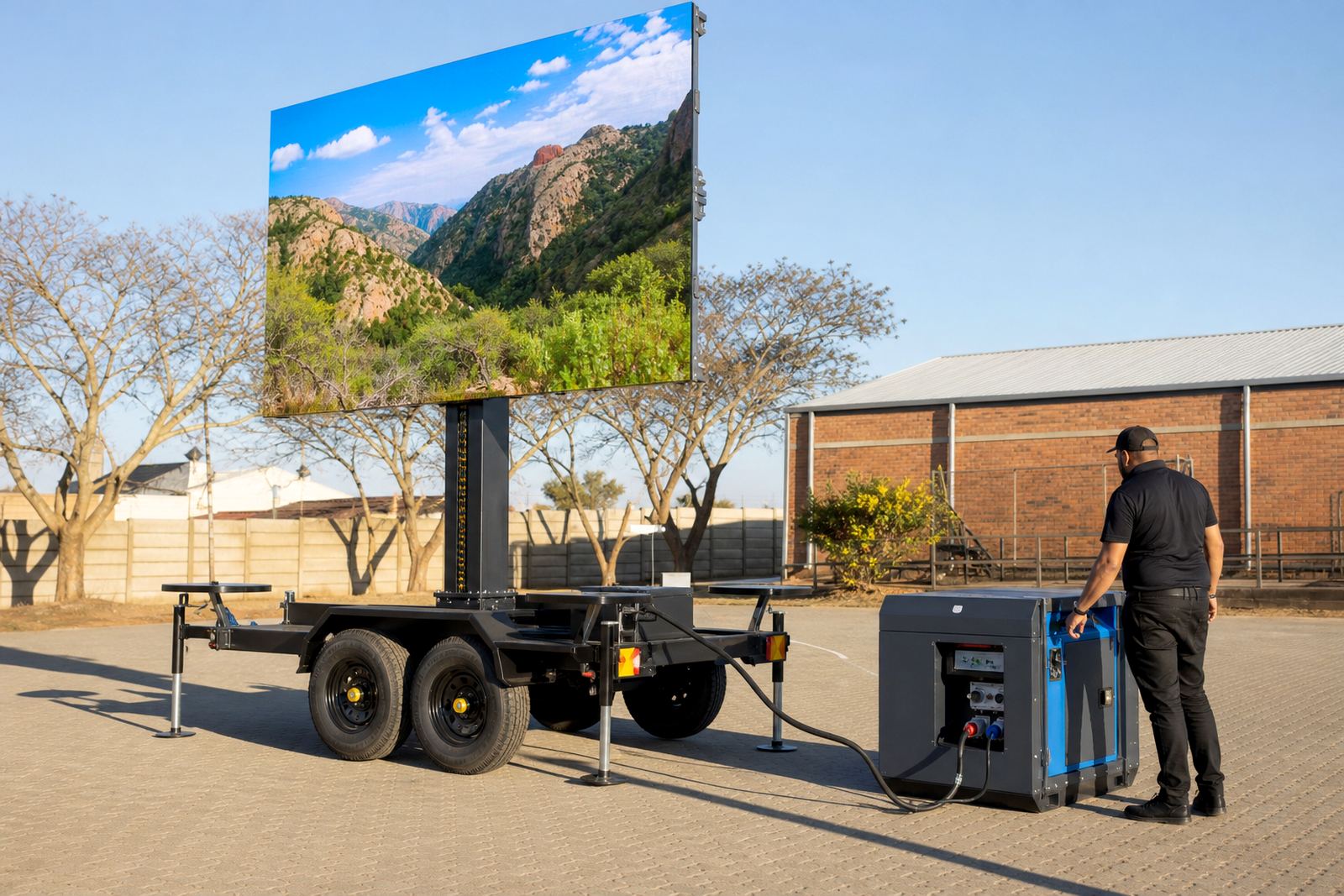
Outdoor LED screens can run from a generator or a suitable mains supply, depending on the site. The decision affects cable runs, noise, operating costs and how much room is needed around the trailer. For a long daytime event, power planning should sit alongside the viewing distance discussion, because a screen that is perfectly sized but poorly powered will not serve the audience well.
Playback is equally important. Content can be loaded in advance and scheduled, while live feed support helps when sport, announcements or last-minute updates must appear on screen. If the crowd is far away, content should be simplified early in the design stage, so the screen is not carrying too much fine detail for the distance involved.
- Check wind limits before the trailer is raised
- Allow space for safe anchoring and access barriers
- Confirm permit needs with the local authority where required
- Plan for weather monitoring if the site is exposed
Municipal permissions can differ by area, especially where the screen faces public roads, traffic points or busy gathering spaces. The practical side is usually about visibility, public safety and placement, so the permit conversation should start early enough to avoid last minute changes.
How far back the crowd really stood
Take a roadshow starting in Germiston and moving through Ekurhuleni, then on to Johannesburg and Pretoria. In the first stop, the audience may gather quite close to the trailer, with people reading a programme, sponsor names and short calls to action. At the later stops, the same content may be viewed from further back, across a parking area or along a temporary spectator edge.
That means the screen choice should not be made for the closest stop only. A medium to large outdoor unit with a pitch suited to mid-range viewing can often handle all three types of site if the artwork is kept disciplined. If the brief includes live sport or daylight branding, a brighter screen and taller mounting position may matter more than chasing the finest pitch available.
On a job like this, our team watches the practical details: approach road, setup ground, speaker position, sightline to the crowd and the nearest safe working edge. Anika Chetty handles operations, Thabo Bhengu oversees screen setup, Noluthando Maluleke coordinates movement between stops, and Sibusiso Shezi keeps the overall brief aligned with the job on site.
A quick rule for matching distance to screen choice
If your nearest viewers will stand close, go finer on pitch and keep the content simple and bold. If the audience sits further out, size and brightness start to carry more weight, and the pixel pitch can be a little coarser without losing legibility. The best result comes from balancing those three pieces instead of chasing one number only.
Before any hire or build is finalised, we look at the crowd distance, the light, the route, the expected wind and the power option. Then the screen suits the crowd as well as the quote. For advertisers, sports days, concerts and roadshows, the viewing distance is often the piece that decides whether the screen feels sharp or merely large.
Our contact form is the right place to share the site, town, audience distance and the kind of content you want to play. From there, the viewing plan can be matched to the trailer or LED box that suits the job.